


Page 51 - Demo
P. 51
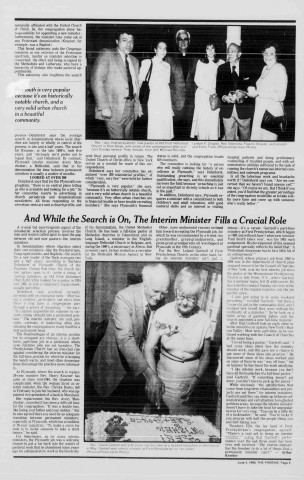
nominally affiliated with the United Church of Christ. So, the congregation alone has responsibility for appointing a new minister; furthermore, the minister may come out of any Protestant denomination (Kruener, for example, was a Baptist).This broad autonomy puts the Congregationalists at one extreme of the Protestant spectrum, insofar as minister selection is concerned; the other end being occupied by the Methodists and Lutherans, who have a hierarchy of bishops who make pastoral appointments.This autonomy also lengthens the searchlouth is very popularoecause it%u2019s an historicallynotable church, and avery solid urban churchin a beautifulcommunity.process%u2014Delmhorst says the average search, in denominations where local churches are largely or wholly in control of the process, is two and a half years. The search for Kruener, in the late 1950%u2019s, took five years, and \repeat that,\Plymouth interim minister Avery Manchester, a Methodist, said that in his denomination the time between permanent ministers is usually a matter of months.LOOKED AT OVER 200 Delmhorst says that for the Plymouth congregation, %u201cthere is no central place telling us who is available and looking for a job.\her committee resorts to advertising in church periodicals and denominational newsletters. All those responding to the advertisei lents are sent a church profile, andR ev. i a r ry V e e n s t r a ( c e n t e r ) . n e w p a s t o r at O ld F ir s t R e f o r m e d I y n d e ll F. C h a p lin . R ev. V e e n s t r a . F r a n c i s C h a p lin , a n d J o s e p h C h u rc h in Park Slope, w ith so m e of the c o n g re g a tio n after a re and E m ily Farre. (P hoenix/G arcilazo Photo) cent S unday service. They include, from left: M ichael P errotta.send their personal profile in return. The United Church of Christ office in New York serves as a conduit for much of this correspondence.Delmhorst says her committee has examined %u201cover 200 ministerial profiles,%u201d of which %u201cvery, very few%u201d were held for further consideration.%u201cPlymouth is very popular,%u201d she says, %u201cbecause it%u2019s an historically notable church, and a very solid urban church in a beautiful community. Very often urban churches are in financial trouble or have trouble recruiting members.%u201d She says Plymouth%u2019s financialstatus is solid, and the congregation boasts 450 members.The committee is looking for %u201ca person who will really continue the history of excellence at Plymouth,%u201d says Delmhorst. Outstanding preaching is an essential qualification, she says, and this immediately narrows the field because %u201cpreaching is just not as important in divinity schools as it was in the past.%u201dIn addition, Delmhorst says, Plymouth requires a minister with a commitment to both children%u2019s and adult education, with good Dastoral skills and an interest in visitinghospital patients and doing preliminary counselling of troubled people, and with administrative abilities sufficient to the task of running the church%u2019s numerous internal committees and outreach programs.Is all the laborious work and heartache worth it? Delmhorst says yes. %u201cAre we concerned that we haven%u2019t found anyone yet?%u201d she says. %u201cOf course we are. But I think if you asked, you%u2019d find that the greater percentage of the congregation would like us to take a little more time and come up with someone who%u2019s really better.%u201dA n d W h i l e t h e S e a r c h i s O n , T h e I n t e r i m M i n i s t e r F i l l s a C r u c i a l R o l eA crucial but easy-to-ignore aspect of the ministerial selection process involves the men and women called upon to span the gap between old and new pastors%u2014the interim ministers.In denominations where churches select their own ministers%u2014like the Presbyterians, Congregationalists, and Baptists-the search for a new leader of the flock averages two and a half years; according to Barbara Delmhorst of Plymouth Church of the Pilgrims. During that time, the church has two options open to it: invite a string of visiting ministers, as Old First Reformed Church did while looking for a pastor in 1984 and 1985. or hire a temporary replacement, usually part-time.Delmhorst said practical necessity dovetails with psychological need. \ing a minister, particularly one who%u2019s been there a long time, a congregation goes through a period of 'mourning,' %u201d she says. \ceed coming straight into a permanent position.\vides continuity of leadership while also allowing the congregation to ready itself for a new permanent head.The disadvantages of an interim position for its occupant are obvious: it is a shortterm, part-time job in a profession where even full-time jobs are not lucrative. The Presbyterian Church has an iron-clad rule against considering the interim minister for the full-time position for which he is keeping the bench warm, and most other denominations discourage the practice more informallyAt Plymouth, where the search to replace 24-year minister Rev. Harry Kruener has gone on since mid-1984, the situation was complicated when the woman hired as interim minister, the Rev. Christa Burns, left in February to join her husband, who was appointed vice-president of a bank in Maryland.Her replacement, the Rev. Avery Manchester, conceded it has been a difficult time for the congregation. %u201cIt was a double loss, like losing your father and your mother.%u201d But he also agreed there is a need for an adequate transition between permanent ministers; especially at Plymouth, which has a tradition of 20-year ministries. %u201cTo make a move too soon is to invite someone to take a short tenure,%u201d he said.f or iviancnesier, as for many interim ministers, the Plymouth job was a welcome chance to put a toe back into the waters of pastoral work that he abandoned some years ago for administrative work in the hierarchyof his denomination, the United Methodist Church. He has been a full-time pastor at Methodist churches in Connecticut and on Long Island, a minister in the Englishlanguage Methodist Church in Belgium, and, during the 1960%u2019s, a missionary in Africa. But in recent years, he has worked as a recruiter for the Methodist Mission Agency in New York.Other, more sentimental reasons inclined him toward accepting the Plymouth job, for which he was recommended by a friend: his grandm other, great-grandparents, and great-great-grandparents all worshipped at Plymouth in the 19th Century.For the Rev. Leland Gartrell of First Presbyterian Church, on the other hand, being an interim minister isn%u2019t just aRev. i e la n d G a r t r e ll a n d w i f e J o y c e c u t t h e c a k e at a fa r e w e ll r e c e p t i o n in t h e i r h o n o r in May. G artrell w as inte rim m in is te r at First P resbyterian for tw o years. (P h o e n ix /R o s e n sto ck Photo)detour%u2014it%u2019s a career. Gartrell%u2019s part-time ministry at First Presbyterian, which began in 1983 and will end June 1 when new minister Paul Smith takes over, was his 10th such assignment. His development of this unusual pastoral specialty reflects his belief that %u201cA Protestant clergyman has to be a little bit of an entrepreneur.%u201dGartrell, whose primary job from 1956 to 1984 was in the department of church planning and research for the Council of Churches of New York, took his first interim job when the pastor of the Westminster Presbyterian Church in Salt Point, N.Y., where Gartrell has a summer home, fell ill with cancer. He was asked to conduct Sunday services in the absence of the regular minister, but the job quickly grew.I was just going to do some weekend preaching,%u201d recalled Gartrell, \7-year-old girl in the community died, and I realized how bereft they were without the continuity of a minister.%u201d So he took on a fuller array of pastoral duties until the church appointed a new full-time minister.After that Gartrell took on eight other interim ministries in upstate New York%u2019s Hudson Valley. Most were part-time, so he continued working with the Council of Churches at the same time.\had some ideas about how the ministry should work, and this gave me a chance to put some of those ideas into practice.%u201d He discovered some of his ideas worked and on some of them he was %u201cway off base,%u201d but on balance he has found the work satisfying.%u201c I like interim work, because you don't have all the headaches of a full-time pastor,%u201d said Gartrell. %u201c If something doesn%u2019t get done; you don%u2019t have to pick up the pieces.%u201d While obviously %u201cthe satisfactions that come from long-term relationships and projects are not there%u201d for interim ministers, Gartrell said they can shake up lethargic administrations and call attention to neglected problem areas, because the interim minister doesn't have to take the heat for unpopular moves for very long. %u201c You can be a little bit of a taskm aster,%u201d he said. %u201cYou%u2019re lucky if you emerge with half the people liking you and half hating you.%u201dTheodore Ells, the lay head of First P re sb y te ria n %u2019s congregation, agreed: %u201c There%u2019s a real art to being an interimm im nfnt* %u201d tR ot H o rf ro ll 'o n o rfn r.inance over the last three years has been very well received. %u201cThe interim minister has the freedom to do a lot of things that a permanent minister can%u2019t.%u201d %u2014 Arthur KroeberJune 5, 1986, TH E P H O E N IX , Page 5


