


Page 514 - Demo
P. 514
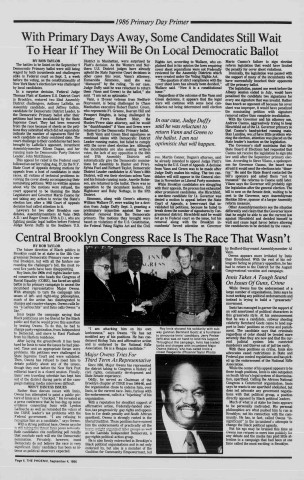
1986 Primary Day PrimerWith Primary Days Away, Some Candidates Still Wait-w- r* i o Hear if They Will Be On Local Democratic BallotBY ROB TAYLORThe battles to be listed on the September 9 Democratic Primary ballot were still being waged by both incumbents and challengers alike in Federal court on Sept. 2, a week before the voting, as the constitutionality of New York State%u2019s election law was challenged by local candidates.In a surprise decision, Federal Judge Thomas Platt of Eastern U.S. District Court in Brooklyn, restored two 52nd Assembly District challengers, Anthony LaBella, an Assembly candidate, and Jeffrey Golkin, candidate for Democratic District Leader, to the Democratic Primary ballot after their petitions had been invalidated by the State Supreme Court. They had been removed from the race because of sheets on the petitions they submitted which did not separately indicate the number of signatures filed for each candidate on their combined slate. The court challenge to their candidacies had been brought by LaBella%u2019s opponent, incumbent Assemblymember Eileen Dugan, and her running mate for Democratic Party District Leader, John McElhinney.This appeal for relief in the Federal court followed an earlier ruling Aug. 27, by the N.Y. State Court of Appeals denying motions for appeals from a host of candidates in state races, all victims of technical problems involving the cover sheets accompanying their nominating petitions. With no written opinion about why the motions were refused, the court appeared to be blaming the State Legislature and Governor Mario Cuomo for not taking any action to revise the State%u2019s election law, after a 1985 Court of Appeals decision had called attention to it.Lawyers for two other Brooklyn candidates, Assemblymembers A1 Vann (56th A.D.) and Roger Green (57th A.D.), who are fighting similar legal battles before Federal Judge Kevin Duffy in the Southern U.S.District in Manhattan, were surprised by Platt%u2019s decision. As the Western and Northern U.S. District judges have already upheld the State Supreme Court decisions in other cases this year, Vann%u2019s attorney, Esmarelda Simmons, said she was %u201cdismayed%u201d by the ruling. %u201cIn our case, Judge Duffy said he was reluctant to return them (Vann and Green) to the ballot,%u201d she said. %u201cI am not as optimistic.%u201dVann, a 12-year veteran from BedfordStuyvesant, is being challenged by Chase Manhattan executive Robert Hunter. Green, who represents Ft. Greene, Boerum Hill and Prospect Heights, is being challenged by Stanley Frere. Robert Muir, theH unter/Frere slate attorney, said he would be %u201cdumbfounded%u201d if Vann and Green were returned to the Democratic Primary ballot.Both Vann and Green filed signatures on combined slates with Democratic District Leader running mates, but failed to comply with the cover sheet election law. Although the incumbents are also seeking write-in votes, the lack of any opposition in the 56th and 57th Assembly Districts willautomatically give the Democratic nominations for Assembly to Hunter and Frere. Sylvia Fuel and Richard Taylor, Democratic District Leader candidates in A1 Vann%u2019s 56th District, will win their elections unless Vann and his female running mate, Annette Robinson, are returned to the ballot. There was no opposition to the incumbent leaders, Ed Hightower and Ruby Nottage, in the 57th District.Simmons, along with Green%u2019s attorney, William Wallace IV, were waiting for a decision from Judge Duffy Sept. 3, granting a preliminary injunction against the candidates%u2019 removal from the Democratic primary. The motions they brought were based on violations of the U.S. Constitution, the Federal Voting Rights Act and the CivilRights Act, according to Wallace, who explained that in his opinion the laws requiring cover sheet separations were not Federally reviewed for me Assembly Districts which were created under the Voting Rights Act.%u201cThe question of strict compliance with the cover sheet laws has already been decided,%u201d Wallace said. %u201cNow it is a constitutional issue.%u201dRegardless of the outcome of the Vann and Green decisions, it appears that the legal wars will continue with some local candidacies not being determined until electionIn our case, Judge Duffysaid he was reluctant toreturn Vann and Green tothe ballot. Iam notoptimistic that will happen.eve. Martin Conner, Dugan%u2019s attorney, said he already intended to appeal Judge Platt%u2019s ruling to the U.S. Court of Appeals. A decision from Vann and Green was to be made after Judge Duffy makes his ruling. The two candidates will still appear in the General election in November as Liberal Party nominees.While Brooklyn candidates are struggling with their appeals, the process has exhausted other prominent candidates. Abe Hirschfeld, a one-time candidate for Lt. Governor was denied a motion to appeal before the State Court of Appeals, a lower-court that invalidated his petitions, because he failed to break down the number of signatures by Congressional district. Hirschfeld said he would not go to Federal court on the issue, but his removal along with the Brooklyn incumbents%u2019 forced attention on GovernorMario Cuomo%u2019s failure to sign election reform legislation that would have limited the penalty for cover sheet violations.Ironically, the legislation was passed with the support of many of the incumbents who have successfully knocked their opponents off the primary ballot.The legislation, passed one week before the Albany session ended in July, would have penalized the candidate two signatures for every one signature that was invalid. Rather than knock an opponent off because his cover sheet was improper, it would have penalized the nominating petition with signature removal rather than complete invalidation.With the Governor and his attorney son, Andrew Cuomo, aggressively trying to keep Hirschfeld out of the Lt. Governor primary so that Cuomo%u2019s hand-picked running mate, Stan Lundine, would have little problem winning the election, attention was placed on the State leader%u2019s inaction on the legislation.The Governor%u2019s staff maintains that the State Board of Elections had requested that Cuomo not receive the legislation to sign into law until after the September primary election. According to Steve Vilano, a spokesperson for Governor Cuomo, the board was afraid it would send the elections into %u201cdisarray.%u201d He said the State Board contacted the bill%u2019s sponsors and asked them %u201cnot to transmit%u201d the reforms to Cuomo until later. Vilano says the Governor will probably sign the legislation after the general election. The bill is now on the Senate desk, waiting to be sent to the Governor, says Assemblyman Sheldon Silver, sponsor of a larger Assembly reform measure.Other Assemblymembers see the situation differently and claim that the Governor knew that he might be able to use the current law against Hirschfeld and decided himself to wait and cause legal havoc before allowing the candidacies to be decided by the voters.Central Brooklyn Congress Race Is The Race That Wasn%u2019tBY ROB TAYLORThe future direction of Black politics in Brooklyn could be at stake in the 12th Congressional Democratic Primary race in central Brooklyn, but with all the fanfare surrounding the challenger%u2019s bid, the most recent five yards have been disappointing.Roy Innis, the 1960s civil rights leader turned conservative who heads the Congress of Racial Equality (CORE), has faced an uphill battle in his primary campaign to unseat the incumbent representative Major Owens. With attempts to turn the campaign into issues of left- and right-wing philosophies, much of the action has disintegrated to charges and counter-charges. Owens calls Innis %u201ca LaRouchite%u201d and Innis calls Owens %u201ca liar.%u201dInnis began the campaign saying that Black politicians are too liberal for the Black public and that he would prove this assertion by beating Owens. To do this, he had to change party-registration, from Independent to Democrat, and move to East Flatbush from his Harlem residence.After laying the groundwork it has been hard for Innis to raise the issues he had planned. Time and an appropriate forum were problems. His petitions were challenged in State Supreme Court and were validated. Then, Owens has refused to meet him to debate publicly about any of the issues, though they met before the New York Post editorial board in a closed session. Finally, Innis%u2019 own traveling schedule has kept him out of the district during parts of the campaign making media interviews difficult.WON%u2019T DISCUSS ISSUESRather than discuss issues with Innis, Owens has attempted to paint a public picture of Innis as a %u201ccrackpot.%u201d He revealed at a press conference that he has dug up some evidence connecting Innis with Lyndon LaRouche as well as reminded the voters of the CORE leader%u2019s tax problems with the Federal government. %u201cI am refusing to recognize him as a candidate,%u201d says Owens.With a strong political base, Owens says heIs Still t^kir.^ t h r o a t T n n ic n o c p q QPrimxilvBoth candidates cite conflicting poll results that conclude each will win the Democratic nomination. Privately, however, most Democrats do not believe the race is very significant. Innis%u2019 candidacy has been as intense as political observers expected.%u201cI am attacking him on his own lawlessness,%u201d says Owens. %u201cHe has not modified any of his positions. He has condemned Bishop Tutu and affirmative action and is endorsed by the National Rifle Association. He is a Reagan candidate.%u201dMajor Owens Tries ForThird Term As RepresentativeSince 1982, Major Owens has represented the district taking to Congress a history of civil rights, community development and State Senate experience.Oddly, he served as Chairman of the Brooklyn chapter of CORE from 1964-66, and the organization chose to endorse him, over Innis, in the current race. Innis, furious with the endorsement, calls it a %u201chijacking%u201d of his organization.With a reputation for steadfast support of affirmative action, Federally-funded abortion, tax progressivity gay rights and opposition to t ie death penalty and South African apartheid, Owens is strongly rooted in the liberal tradition. These positions have earned him the endorsements of practically all the%u00bb%u00bb%u00bb/-*%u00bb A r r Y o n i 'i a r l 1 o K n r ( T r A t m c q c w o l l \''*0*'**%u201c%u201c''%u201c -------- o%u201c r - %u2014 - %u2014as the Lambda Independent Democrats, a gay-rights political action group.He is also firmly entrenched in Brooklyn%u2019s Black political organizations and is not only endorsed by, but also is a member of the Coalition for Community Empowerment, ledRoy Innis showed his solidarity with subway gunman Bernhard Goetz at a fundraiserto announce Innis%u2019 candidacy. Jerry Preiser(left) also was on hand to lend his support.Throughout the campaign, Innis has tradedbarbs and charges with incum bent MajorOwens (below), who has called Innis acloset Reaganite. (Phoenix/Taylor Photo)by Bedford-Stuyvesant Assemblymember A1 Vann.Owens appears more irritated by Innis than threatened. With the rest of his colleagues facing no primary opposition, he has had to return to the District for the August Congressional vacation and campaign.Innis Takes A Tough StandOn Issues O f Guns, CrimeWhile Owens has the endorsement of a large number of organizations, Innis says he is not seeking any political endorsements and instead is trying to build a %u201cgrassroots%u201d movement.Innis has managed to gamer the support of an odd assortment of political characters in this grassroots style. At his announcement that he was a candidate, subway shooting celebrity Bernhard Goetz came to lend support to Innis%u2019 positions on crime and punishment. The candidate says that criminals regardless of color should be treated more severely than they are now and that the current judicial system lets convicted murderers and thieves out of jail too early.With these positions on crime, Innis also advocates eased restrictions in State and Federal gun control regulations and has picked up the endorsement of the National Rifle Association.While the center of his appeal appears to be these tough positions, Innis is also outspoken on South Africa%u2019s legal system of discrimination, apartheid. Calling the African National Congress a Communist organization, Innis says he wants to see apartheid abolished, but does not advocate any goverment negotiations with that political group, a position directly opposed by Black political leaders.Much of what is at stake for Innis appears to be personally motivated. His personal philosophies are what pushed him to run in Brooklyn; not his connection with the community. He has, in fact, called Owens %u201cinsignificant%u201d in the incumbent%u2019s attempts to change the Black political agenda.But his ego may be bruised this time as Owens has refused to meet him puhiiciy fui any debate and the media has paid little attention to a campaign that had been at one time called the most exciting in Brooklyn.Page 6, THE PH O EN IX, Septem ber 4, 1986


