


Page 209 - UAE Ministry of Culture PR REPORT - SEPTEMBER 2025
P. 209
9/12/25, 2:54 PM                   UAE-led restoration project removes scars of Mosul’s ISIS destruction | The National
        Bridge of cultures
        Their restoration represents more than the revival of stone: it is the revival of hope, sending a powerful message of coexistence.

        In April 2018, less than a year after the Iraqi army reclaimed Mosul following a brutal battle that destroyed nearly 80 per cent of
        the city, Ms Al Kaabi launched the project from Baghdad. Seven years later, she walked into Mosul, announcing its completion.

        "Completing this project is a testament to the resilience of Iraqis in the face of terror, said Mr Al Sudani. “I want to thank
        everyone who worked to revive this rich legacy, and especially the UAE and Unesco.”


        For centuries, Mosul has lived up to its Arabic name, which translates as “Linking Point”, a bridge between regions and cultures.
        The city became a crucible of Iraq’s diverse identity, marked by the coexistence of its ethnic, linguistic and religious groups.

        When ISIS controlled the country's second-largest city, Christians were driven from their homes. Most who could not escape
        were killed. Churches and Christian heritage sites were either demolished or vandalised.


        From the ashes of war
        From the outset, the project faced major challenges. Thousands of tonnes of rubble had to be carefully removed and sifted for
        salvageable pieces. Workers also had to remove dangerous ordnance, including an unexploded bomb found beneath the
        mosque’s dome.

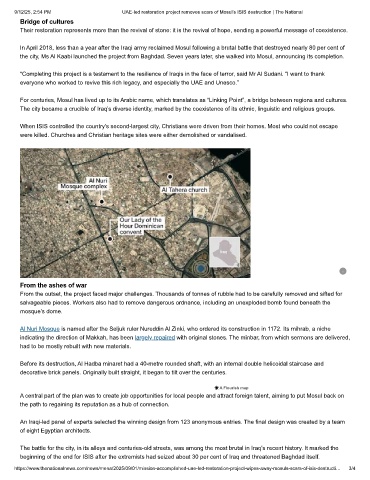
        Al Nuri Mosque is named after the Seljuk ruler Nureddin Al Zinki, who ordered its construction in 1172. Its mihrab, a niche
        indicating the direction of Makkah, has been largely repaired with original stones. The minbar, from which sermons are delivered,
        had to be mostly rebuilt with new materials.

        Before its destruction, Al Hadba minaret had a 40-metre rounded shaft, with an internal double helicoidal staircase and
        decorative brick panels. Originally built straight, it began to tilt over the centuries.


                                                                          A Flourish map
        A central part of the plan was to create job opportunities for local people and attract foreign talent, aiming to put Mosul back on
        the path to regaining its reputation as a hub of connection.

        An Iraqi-led panel of experts selected the winning design from 123 anonymous entries. The final design was created by a team
        of eight Egyptian architects.


        The battle for the city, in its alleys and centuries-old streets, was among the most brutal in Iraq’s recent history. It marked the
        beginning of the end for ISIS after the extremists had seized about 30 per cent of Iraq and threatened Baghdad itself.
      https://www.thenationalnews.com/news/mena/2025/09/01/mission-accomplished-uae-led-restoration-project-wipes-away-mosuls-scars-of-isis-destructi…  3/4

