


Page 706 - Royal Liverpool Philharmonic Coverage Book 2023-24
P. 706
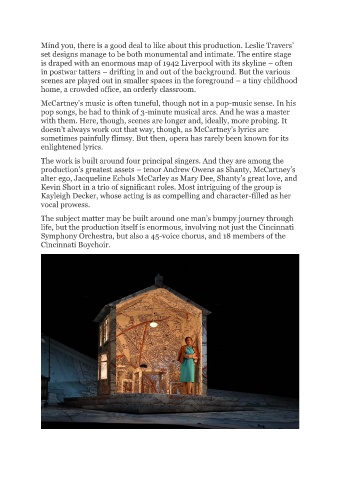
Mind you, there is a good deal to like about this production. Leslie Travers’
               set designs manage to be both monumental and intimate. The entire stage
               is draped with an enormous map of 1942 Liverpool with its skyline – often
               in postwar tatters – drifting in and out of the background. But the various
               scenes are played out in smaller spaces in the foreground – a tiny childhood
               home, a crowded office, an orderly classroom.

               McCartney’s music is often tuneful, though not in a pop-music sense. In his
               pop songs, he had to think of 3-minute musical arcs. And he was a master
               with them. Here, though, scenes are longer and, ideally, more probing. It
               doesn’t always work out that way, though, as McCartney’s lyrics are
               sometimes painfully flimsy. But then, opera has rarely been known for its
               enlightened lyrics.

               The work is built around four principal singers. And they are among the
               production’s greatest assets – tenor Andrew Owens as Shanty, McCartney’s
               alter ego, Jacqueline Echols McCarley as Mary Dee, Shanty’s great love, and
               Kevin Short in a trio of significant roles. Most intriguing of the group is
               Kayleigh Decker, whose acting is as compelling and character-filled as her
               vocal prowess.

               The subject matter may be built around one man’s bumpy journey through
               life, but the production itself is enormous, involving not just the Cincinnati
               Symphony Orchestra, but also a 45-voice chorus, and 18 members of the
               Cincinnati Boychoir.

