


Page 34 - Papworth Trust - Facts & Figures 2018
P. 34
The Employment Gap
•	The disability employment gap can be defined as the difference in the employment rate of disabled people and non-disabled people. 210
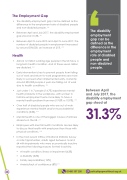
•	Between April and July 2017, the disability employment gap stood at 31.3%. 211
•	Between April to June 2013 and April to June 2017, the number of disabled people in employment increased by around 596,000, an increase of 21%. 212
Health
•
•
•
•
• •
•
Almost 12 million working age people in the UK have a long-term health condition. And of these seven million are disabled. 213
Early intervention is key to prevent people from falling out of work and return-to-work programmes are more likely to succeed when implemented early. Currently, around 300,000 people a year are falling out of work due to health conditions. 214
Just under 1 in 7 people (14.7%) experience mental health problems in the workplace, with women in full-time employment twice more likely to have a mental health problem than men (19.8% vs 10.9%). 215
Over half of disabled people who are out of work experience mental health and/or musculoskeletal conditions (54%). 216
Mental health is one of the biggest causes of sickness absence in the UK. 217
Employees with mental health conditions are less likely to discuss their health with employers than those with physical conditions. 218
In the most recent Office of National Statistics Survey on Life Opportunities, adults aged between 16 and 64 with impairments who were economically inactive reported the following reasons for their inactivity:
Between April and July 2017, the disability employment gap stood at
31.3%
• • • •
A health condition, illness or impairment (63%) A disability (32%) Family responsibilities (12%) Anxiety/lack of confidence (8%) 219
01480 357 200	policy@papworthtrust.org.uk
34
The disability employment gap can be defined as the difference in the employment rate of disabled people and non-disabled people.


