


Page 35 - Papworth Trust - Facts & Figures 2018
P. 35
Attitudes
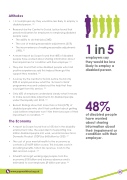
•	1 in 5 employers say they would be less likely to employ a disabled person. 220
•	Research by the Centre for Social Justice found that perceived barriers for employers to employing disabled people were:
• • •
The ability to do their jobs (34%)
The cost of making reasonable adjustments (31%)
The inconvenience of making reasonable adjustments (19%). 221
1in5 employers say
they would be less likely to employ a disabled person.
48%
of disabled people
have worried
about sharing
information about
their impairment or condition with their
employer.
•	A recent report by Scope found that 48% of disabled people have worried about sharing information about their impairment or condition with their employer. 222
•	They also found that some disabled people who had positive experiences said this helped them get the support they needed. 223
•	A survey by the Centre for Social Justice found only 25% of employers knew what the ‘Access to Work’ programme was and understood the help that they could get from this service. 224
•	Only 45% of employers understand clearly what it means to make reasonable adjustments for disabled people under the Equality Act 2010. 225
•	Recent findings show that more than a third (37%) of disabled people who don’t feel confident about getting a job believe employers won’t hire them because of their impairment or condition. 226
The Economy
•
•
•
A report by Scope found that a 10% rise in the disability employment rate, the equivalent of supporting one million disabled people into work, would increase Gross Domestic Product (GDP) by £45 billion by 2030. 227
The cost of poor mental health to the economy as a whole is £74-£99 billion a year. This includes costs in providing benefits, falls in tax revenue, costs to the NHS and lost output. 228
Ill-health amongst working age people costs the economy £100 billion and sickness absence and is estimated to cost employers £9 billion per year. 229
www.papworthtrust.org.uk
35


