


Page 14 - Priorities 6
P. 14
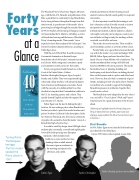
The Woodside Priory School story began 1,450 years ago, with the life of St. Benedict and publication of his Rule, a guideline for community living. Benedictines had a strong influence throughout Europe from that time forward, in part because of the monks’ role in preserving knowledge through the monastic libraries. In 996, St. Stephen, the first king of Hungary, founded in Pannonhalma the St. Martin’s Archabbey, a center of Benedictine learning and the home of Woodside Priory’s founding monks. These monks “never expected to leave their academic life (in Europe),” but Divine Providence dictated otherwise, according to Father Egon Javor.
With the end of World War II and the increase in Communist domination in Eastern Europe, Benedictine schools fell under Communist control and closure. Monks emigrated, sometimes openly and sometimes secretly, in fear for their safety.
Seven young priests found themselves on the East Coast of the United States – Fathers Emidius,Christopher, Benignus, Egon, Leopold, Stanley and Achilles. They were experienced high school and college teachers, with advanced degrees from American and European universities. Faced with the necessity of re-defining their lives, they decided to transplant their Pannonhalma tradition to the U.S. by founding a priory and a school. They quickly learned English and after the required five years became U.S. citizens.
Father Egon took the lead in finding the right location. He was seeking a place where Benedictines had not yet settled, a place that needed teachers and priests. Northern California fit the description. In the San Francisco Peninsula area, he found a community of people who seemed to share the monks’ vision of a Benedictine high school for boys.
It would be small by design, about 100 high school students plus, eventually, a seventh and eighth grade. It would be built upon rigorous European
standards, which included such traditions as coats and ties for class,
standing when an adult entered the room, rigorous academics in
the morning and sports in the afternoon, and careful,
individual attention to the best training of each student’s mind so that all would qualify for respected universities.
No less important would be the forming of each boy’s character, so that all would succeed as citizens and parents in adult life. Boarding students, international students, Catholic students, Catholics who might eventually elect a religious vocation, and non-Catholics willing to study the teachings of their own faith, would all be welcome.
The monks also envisioned fun. There would be close friendships and lots of activities at their school.
Portola Valley was a good choice because the land was within the monks’ very restricted budget. With $80,000, Father Egon purchased from the Gilson family 18 acres of bare hillside with a farmhouse. The monks contributed their savings of $18,000 and borrowed $5,000 for the down payment. The monks had endless hours of planning, building and landscaping work ahead of them, including physical labor on the business end of a pickax and other hand tools. However, they also had a community of good friends, including several who did not have children to enroll but who wanted to support the fledgling Benedictine presence in California. Together they would create a school.
The Benedictine motto adopted by the new school was, and still is, “Ora et Labora” (Work and Prayer). It turned out to be a good description of the 40 years ahead.
(Following are highlights from the Priory’s forty years. They are taken from boxes of books, papers and news clippings, many undated. We did our best and invite your corrections.)
First Decade:
In 1956, Father Egon moved into the little farmhouse and offered the first Holy Mass.
In June 1957, before school opened, Louise (Mrs.
Forty Years ata Glance
Celebrating
40
years
of Benedictine College Preparatory Education
Turning Points: The European heritage:
The first monks opened the Priory school in 1957.
Father Egon
Father Christopher
Father Stanley (picture not available)


