


Page 48 - All Blacks v Lions - First Test
P. 48
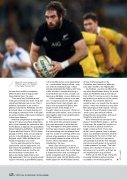
Whitelock on the charge for the All Blacks against the Wallabies in the Rugby Championship
the way fans could be completely different rather than being just like New Zealand fans,” he says.
“They were loud, boisterous and really got in behind their team. That was something that was new to me. Then I de nitely remember us as a nation getting in behind the All Blacks, and the provincial sides, and really helping out with support, whereas I think in the past we were probably a little quiet compared to the Home Nations.”
Whitelock’s experience in that regard is typical of many young New Zealanders, but in other respects his connection with the All Blacks is atypical. His grandfather Nelson Dalzell toured Britain, Ireland and France with Bob Stuart’s 1953-54 team, playing in all  ve Tests, and scoring the only try in the All Blacks’ 5-0 win over England, while 1980s All Blacks lock Graeme Higginson is an uncle.
But he was oblivious to the family connections until his early teens. He didn’t know his grandfather, who died when Whitelock was six months old,
and he reckons he was about 14
before the family rugby history was
fully appreciated. “For me, growing up with rugby in the blood, a grandfather playing
in the mid-50s and an uncle playing later on – and brothers being involved – was one of those amazing things. I didn’t actually understand the history until I was a little bit older. I thought that being a rural kid there was no way I would ever become an All Black, or even talk to one.
“I didn’t actually know my uncle was one – I’d spent some time with a really good family friend, Gary Knight, who was a very successful All Black, and I began to work a few things out. I thought, ‘Hang on a second, I think I’ve heard that name before,’ and I joined the dots together and it was amazing when all that happened.
“I could see that I’d been surrounded by it the whole time and just realised they were awesome in what they did. They managed to have great careers, but they were down-to-earth people and that’s something that has always stuck with me. It was one of things where you did ask a few questions, but more you just sat and listened to a few of the old stories, which was always pretty entertaining,” he says.
What it also did was point out to
him that it was possible to achieve the All Blacks dream even from a rural base. It helped that there was no shortage of family competition with his brothers, George and Luke, also All Blacks, while Adam played for the All Blacks Sevens.
All four brothers played for the Crusaders and Canterbury, although Luke later moved to the Highlanders.
“As brothers, we were no different to any other New Zealand family. We would watch the All Blacks and do the haka in front of the TV, and go out on to the lawn and pretend you were one of the current All Blacks. Your brothers had to be someone else; you couldn’t be the same person. It was very similar to every other Kiwi upbringing in that respect,” he says. “It was the time of Christian Cullen and Jonah Lomu, and being a forward, Zinzan Brooke was another, and we all thought he was pretty cool.”
Now, Whitelock has carved his own place in that All Blacks legacy – and the Lions loom. He knows their reliance on the set piece is going to make for a tough contest up front. “If you look
at the Lions in general, they’ve always had a very dominant set piece, whether that’s playing for the Lions or their own countries. So,  rst of all, we have to acknowledge that will be their strength and come up with a plan to try and put it under pressure,” he says. “The best way for us to do that is to ensure our set piece is up to scratch, and then we can hopefully have a go at theirs.”
If they can do that, it’ll go a long way to seeing Whitelock add yet another accolade to an already superb list.
48 // OFFICIAL SOUVENIR PROGRAMME
GETTY IMAGES


