


Page 112 - Data Structures Handout
P. 112
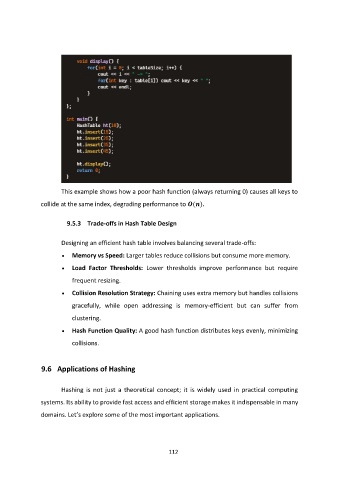
This example shows how a poor hash function (always returning 0) causes all keys to

               collide at the same index, degrading performance to   (  ).


                         9.5.3  Trade-offs in Hash Table Design


                       Designing an efficient hash table involves balancing several trade-offs:
                       •  Memory vs Speed: Larger tables reduce collisions but consume more memory.

                       •  Load  Factor  Thresholds:  Lower  thresholds  improve  performance  but  require

                          frequent resizing.

                       •  Collision Resolution Strategy: Chaining uses extra memory but handles collisions
                          gracefully,  while  open  addressing  is  memory-efficient  but  can  suffer  from

                          clustering.

                       •  Hash Function Quality: A good hash function distributes keys evenly, minimizing

                          collisions.


                9.6    Applications of Hashing


                       Hashing  is  not  just  a  theoretical  concept;  it  is  widely  used  in  practical  computing

               systems. Its ability to provide fast access and efficient storage makes it indispensable in many
               domains. Let’s explore some of the most important applications.


                                                            112

