


Page 102 - Atlas Sea Birds Ver1
P. 102
Sherley RB, Crawford RJM, Dyer BM, Kemper J, Makhado AB,   Kemper J  (eds).  Birds to  watch in Namibia: red,  rare  and
                      Masotla M, Pichegru L, Pistorius PA, Roux J-P, Ryan PG, Tom   endemic species. Windhoek; Ministry of  Environment  and
                      D, Upfold L, Winker H. 2019. The status and conservation of   Tourism and Namibia Nature Foundation: pp. 86–87.
                      Cape Gannets Morus capensis. Ostrich 90: 335–346.  Simmons RE, Boix-Hazen C, Barnes KN, Jarvis AM, Robertson A.
                  Simmons RE.  2015a. Caspian Tern  Hydropogne  caspia (Sterna   1998. Important bird areas of Namibia. In: Barnes K (ed.).
                      caspia). In: Simmons RE, Brown CJ, Kemper J (eds). Birds to   The Important Bird Areas of Southern Africa, BirdLife South
                      watch in Namibia: red, rare and endemic species. Windhoek;   Africa, Johannesburg, 295–332.
                      Ministry  of  Environment and  Tourism and Namibia  Nature     Tom DB, Crawford RJM, Makhado AB. 2024. Harvests of seabird
                      Foundation: pp. 88–90.                            guano in the Benguela upwelling ecosystem. This volume.
                  Simmons RE.  2015b. Great  White  Pelican  Pelecanus ono-   Williams  AJ. 1987. New seabird  breeding localities, and an
                      crotalus. In: Simmons RE, Brown CJ, Kemper J (eds). Birds    extension of Bank Cormorant range, along the Namib coast
                      to  watch  in Namibia:  red, rare and  endemic  species.   of southern Africa. Cormorant 15: 98–102.
                      Windhoek;  Ministry of Environment  and  Tourism  and
                      Namibia Nature Foundation: pp. 173–175.       Williams  AJ, Steele  AK, Cooper J, Crawford  RJM. 1990.
                  Simmons  RE. 2015c.  Hartlaub’s Gull  Tern  Chroicocephalus   Distribution, population size and conservation of Hartlaub’s
                      hartlaubii  (Larus  hartlaubii). In: Simmons  RE, Brown  CJ,   Gull Larus hartlaubii. Ostrich 61: 66–76.


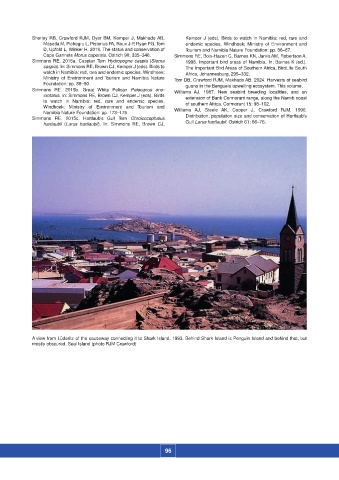
                  A view from Lüderitz of the causeway connecting it to Shark Island, 1993. Behind Shark Island is Penguin Island and behind that, but
                  mostly obscured, Seal Island (photo RJM Crawford)


                                                                 96

