


Page 450 - Atlas Sea Birds Ver1
P. 450
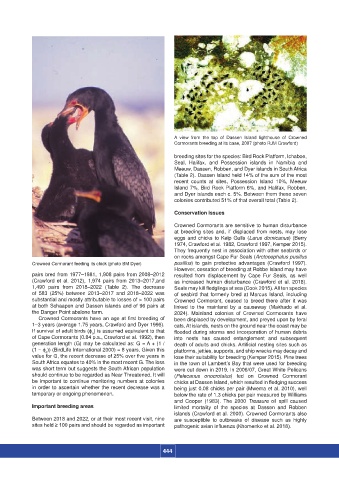
A  view from the  top of  Dassen Island lighthouse  of  Crowned
                                                                    Cormorants breeding at its base, 2007 (photo RJM Crawford)

                                                                    breeding sites for the species: Bird Rock Platform, Ichaboe,
                                                                    Seal, Halifax, and Possession islands in Namibia and
                                                                    Meeuw, Dassen, Robben, and Dyer islands in South Africa
                                                                    (Table 2). Dassen Island held 14% of the sum of the most
                                                                    recent counts at sites, Possession  Island  10%, Meeuw
                                                                    Island 7%, Bird Rock Platform 6%, and Halifax, Robben,
                                                                    and Dyer islands each c. 5%. Between them these seven
                                                                    colonies contributed 51% of that overall total (Table 2).

                                                                    Conservation issues
                                                                    Crowned Cormorants are sensitive to human disturbance
                                                                    at  breeding sites  and, if  displaced from  nests,  may lose
                                                                    eggs and chicks to Kelp Gulls (Larus domicanus) (Berry
                                                                    1974, Crawford et al. 1982, Crawford 1997, Kemper 2015).
                                                                    They frequently nest in association with other seabirds or
                                                                    on rocks amongst Cape Fur Seals (Arctocephalus pusillus
                  Crowned Cormorant feeding its chick (photo BM Dyer)  pusillus)  to  gain protective advantages (Crawford 1997).
                                                                    However, cessation of breeding at Robbe Island may have
                  pairs bred from 1977–1981, 1,908 pairs from 2008–2012   resulted  from displacement  by Cape  Fur Seals, as well
                  (Crawford et  al.  2012), 1,974 pairs from  2013–2017,and   as increased human disturbance  (Crawford et al. 2018).
                  1,490 pairs from 2018–2022  (Table 2).  The decrease   Seals may kill fledglings at sea (Cook 2015). All ten species
                  of  583 (25%) between 2013–2017  and 2018–2022  was   of  seabird that formerly bred at  Marcus Island, including
                  substantial and mostly attributable to losses of > 100 pairs   Crowned  Cormorant, ceased  to breed  there after it was
                  at both Schaapen and Dassen islands and of 96 pairs at   linked  to the mainland  by a causeway  (Makhado  et al.
                  the Danger Point abalone farm.                    2024).  Mainland  colonies  of Crowned  Cormorants  have
                     Crowned Cormorants have an age at first breeding of   been displaced by development, and preyed upon by feral
                  1–3 years (average 1.75 years, Crawford and Dyer 1996).   cats. At islands, nests on the ground near the coast may be
                  If survival of adult birds (ϕ ) is assumed equivalent to that   flooded during storms and incorporation of human debris
                                       α
                  of Cape Cormorants (0.84 p.a., Crawford et al. 1992), then   into nests  has caused entanglement and subsequent
                  generation length (G) may be calculated as: G = A + (1 /   death of adults and chicks. Artificial nesting sites such as
                  (1 − ϕ )) (BirdLife International 2000) = 8 years. Given this   platforms, jetties, supports, and ship wrecks may decay and
                       α
                  value for G, the recent decrease of 25% over five years in   lose their suitability for breeding (Kemper 2015). Pine trees
                  South Africa equates to 40% in the most recent G. The loss   in the town of Lambert’s Bay that were used for breeding
                  was short term but suggests the South African population   were cut down in 2019. In 2006/07, Great White Pelicans
                  should continue to be regarded as Near Threatened. It will   (Pelecanus onocrotalus) fed on Crowned Cormorant
                  be important to continue monitoring numbers at colonies   chicks at Dassen Island, which resulted in fledging success
                  in order to ascertain whether the recent decrease was a   being just 0.08 chicks per pair (Mwema et al. 2010), well
                  temporary or ongoing phenomenon.                  below the rate of 1.3 chicks per pair measured by Williams
                                                                    and  Cooper  (1983).  The 2000  Treasure oil  spill  caused
                  Important breeding areas                          limited mortality  of  the species at  Dassen and Robben
                                                                    islands (Crawford et al. 2000). Crowned Cormorants also
                  Between 2018 and 2022, or at their most recent visit, nine   are susceptible to  outbreaks of  disease such as  highly
                  sites held ≥ 100 pairs and should be regarded as important   pathogenic avian influenza (Khomenko et al. 2018).


                                                                444

