


Page 538 - Atlas Sea Birds Ver1
P. 538
The above 16 sites may be grouped into seven regions
                                                                    that provided  both suitable breeding  habitat and nearby
                                                                    feeding grounds: Ilha dos Tigres, Swakopmund to Walvis
                                                                    Bay, Orange River Estuary, the region between Velddrif
                                                                    saltworks and WCNP (grouped  because of a likelihood
                                                                    that Caspian Terns moved breeding sites in the Berg River
                                                                    Estuary and Langebaan  Lagoon, Crawford et al. 1994),
                                                                    Cape Agulhas vicinity, estuaries and islands in Algoa Bay,
                                                                    and Lake St Lucia. The Berg River Estuary – Langebaan
                                                                    Lagoon region included  three other islands in WCNP
                                                                    (Malgas, Marcus, and Jutten) and Vondeling Island Nature
                                                                    Reserve, where Caspian Terns also bred.
                                                                      In inland  southern  Africa, the last known  record of
                                                                    breeding at Vaal Dam was of four pairs in 1974 (Cooper
                                                                    et al. 1992). Caspian Terns continued to utilise Kalkfontein
                                                                    Dam and occurred sporadically at Barberspan (Marnewick
                                                                    et al. 2015). On 31 January 2015, 106 Caspian Terns were
                                                                    counted at  Barberspan, but  no  breeding was recorded
                                                                    (Coordinated  Waterbird Counts  https://cwac.birdmap.
                                                                    africa/cards_individual.php?card=504768).Caspian
                                                                    Terns were reported to breed at an island at Gariep Dam
                                                                    (Marnewick et al. 2015). Twenty-six pairs bred at Sua Pan
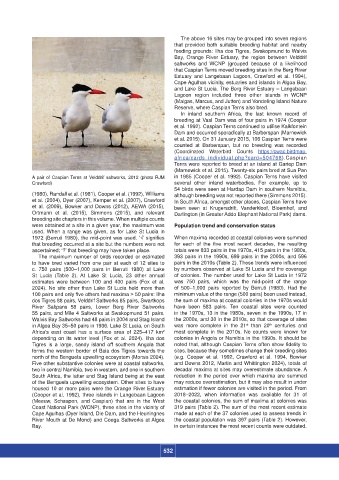
                  A pair of Caspian Terns at Velddrif saltworks, 2012 (photo RJM   in 1985 (Cooper et al. 1992). Caspian Terns have visited
                  Crawford)                                         several  other inland  waterbodies.  For example,  up to
                                                                    54 birds were seen at Hardap Dam in southern Namibia,
                  (1980), Randall et al. (1981), Cooper et al. (1992), Williams   although breeding was not reported there (Simmons 2015).
                  et al. (2004), Dyer (2007), Kemper et al. (2007), Crawford   In South Africa, amongst other places, Caspian Terns have
                  et al. (2009), Bowker and Downs (2012), AEWA (2015),   been seen at Krugersdrift, Vanderkloof, Bloemhof, and
                  Ortmann et al. (2015), Simmons (2015), and relevant   Darlington (in Greater Addo Elephant National Park) dams.
                  breeding site chapters in this volume. When multiple counts
                  were obtained at a site in a given year, the maximum was   Population trend and conservation status
                  used. When a range was given, as for Lake St Lucia in
                  1972 (Berruti 1980), the mid-point was used. ‘√’ signifies   When maxima recorded at coastal colonies were summed
                  that breeding occurred at a site but the numbers were not   for  each  of  the  five  most  recent  decades,  the  resulting
                  ascertained; ‘?’ that breeding may have taken place.  totals were 833 pairs in the 1970s, 415 pairs in the 1980s,
                     The maximum number of birds recorded or estimated    393 pairs in the 1990s, 699 pairs in the 2000s, and 596
                  to have bred varied from one pair at each of 12 sites to    pairs in the 2010s (Table 2). These trends were influenced
                  c.  750 pairs (500–1,000 pairs in Berruti 1980) at  Lake   by numbers observed at Lake St Lucia and the coverage
                  St  Lucia  (Table  2).  At  Lake St  Lucia, 23 other annual    of colonies. The number used for Lake St Lucia in 1972
                  estimates were between  100 and 400 pairs (Fox et al.   was  750  pairs,  which  was  the  mid-point  of  the  range
                  2024).  No site other than Lake  St Lucia  held  more  than   of  500–1,000 pairs reported by  Berruti (1980). Had the
                  100 pairs and only five others had maxima > 50 pairs: Ilha   minimum value of the range (500 pairs) been used instead,
                  dos Tigres 88 pairs, Velddrif Saltworks 85 pairs, Swartkops   the sum of maxima at coastal colonies in the 1970s would
                  River Saltpans 58 pairs, Lower Berg River Saltworks     have been 583 pairs.  Ten coastal sites were counted
                  55 pairs, and Mile 4 Saltworks at Swakopmund 51 pairs.   in the 1970s, 13 in the 1980s, seven in the 1990s, 17 in
                  Walvis Bay Saltworks had 48 pairs in 2004 and Stag Island   the 2000s, and 30 in the 2010s, so that coverage of sites
                  in Algoa Bay 35–50 pairs in 1936. Lake St Lucia, on South   was more complete in the 21  than 20  centuries and
                                                                                                      th
                                                                                             st
                  Africa’s east coast has a surface area of 225–417  km    most  complete in the 2010s. No  counts were known for
                                                                2
                  depending  on its water level  (Fox et al. 2024).  Ilha dos   colonies in Angola or Namibia in the 1990s. It should be
                  Tigres  is  a  large,  sandy  island  off  southern Angola  that   noted that, although Caspian Terns often show fidelity to
                  forms the western border of Baia dos Tigres towards the   sites, because they sometimes change their breeding sites
                  north of the Benguela upwelling ecosystem (Morais 2024).   (e.g.  Cooper et  al. 1992, Crawford et  al. 1994, Bowker
                  Five other substantive colonies were at coastal saltworks,   and Downs 2012, Martin and Whittington 2024), totals of
                  two in central Namibia, two in western, and one in southern   decadal maxima at sites may overestimate abundance. A
                  South Africa, the latter and Stag Island being at the east   reduction in the  period over which maxima are summed
                  of the Benguela upwelling ecosystem. Other sites to have   may reduce overestimation, but it may also result in under
                  housed 10 or more pairs were the Orange River Estuary   estimation if fewer colonies are visited in the period. From
                  (Cooper et al. 1992), three islands in Langebaan Lagoon   2018–2022,  when information  was available  for 31 of
                  (Meeuw,  Schaapen, and Caspian) that are in the West   the coastal colonies, the sum of maxima at colonies was
                  Coast National Park (WCNP), three sites in the vicinity of   319 pairs (Table 2). The sum of the most recent estimate
                  Cape Agulhas (Dyer Island, Die Dam, and the Heuningnes   made at each of the 37 colonies used to assess trends in
                  River Mouth at De Mond) and Coega Saltworks at Algoa   the coastal population was 397 pairs (Table 2). However,
                  Bay.                                              in certain instances the most recent counts were outdated.


                                                                532

