


Page 34 - LHR November 2025
P. 34
and expensive to produce, offers many advantages, from      and  the  New  V2
   improved  performance  to  more  compact  packaging.       ( 9 6 m m   x
   Fabio Taglioni, Ducati's legendary engineer, introduced    6 1 . 5 m m ,
   the desmodromic system to address challenges faced by      8 9 0 c c ) .  A l l
   V-twin engines in the 1960s, particularly the weight of    three  engines
   large  valves  compared  to  the  smaller  valves  found  in   share the same
   multi-cylinder engines like those from Honda.
                                                              b   a   s  i  c
   Ducati is the only manufacturer to have mass-produced      c o m b u s t i o n
   desmodromics, and they've remained a central element in    system  –  four
   Ducati's racing success.                                   v a l v e s   p e r
                                                              c y l i n d e r ,
   In  fact,  Ferrari  even  consulted  Ducati  on  valve  train
   technology, and Ducati's continued use of desmo valves in   naturally  aspirated
   MotoGP  shows  their  ability  to  beat  even  the  likes  of   w i t h   p o r t   f u e l
   pneumatic  valve  springs  –  a  technology  that,  while   injection – and all are
   impressive, is not suitable for mass production.           water-cooled.
                                                              Let's  first  look  at  outright
   Despite my deep admiration for desmodromics, I'll try to
   remain  objective  when  discussing  Ducati's  new  V2     performance.
   engine.  This  new  engine  is  notably  lighter  than  other
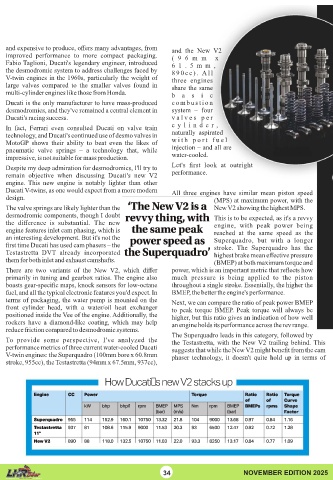
   Ducati V-twins, as one would expect from a more modern     All  three  engines  have  similar  mean  piston  speed
   design.
                                                                              (MPS) at maximum power, with the
   The valve springs are likely lighter than the                              New V2 showing the highest MPS.
   desmodromic components, though I doubt                                     This is to be expected, as it's a revvy
   the  difference  is  substantial.  The  new                                 engine,  with  peak  power  being
   engine features inlet cam phasing, which is                                reached  at  the  same  speed  as  the
   an interesting development. But it's not the                               Superquadro,  but  with  a  longer
   first time Ducati has used cam phasers – the                                stroke.  The  Superquadro  has  the
   Testastretta  DVT  already  incorporated                                   highest brake mean effective pressure
   them for both inlet and exhaust camshafts.
                                                                              (BMEP) at both maximum torque and
   There  are  two  variants  of  the  New  V2,  which  differ   power, which is an important metric that reflects how
   primarily in tuning and gearbox ratios. The engine also    much  pressure  is  being  applied  to  the  piston
   boasts gear-specific maps, knock sensors for low-octane     throughout a single stroke. Essentially, the higher the
   fuel, and all the typical electronic features you'd expect. In   BMEP, the better the engine's performance.
   terms of packaging, the water pump is mounted on the       Next, we can compare the ratio of peak power BMEP
   front  cylinder  head,  with  a  water/oil  heat  exchanger   to peak torque BMEP. Peak torque will always be
   positioned inside the Vee of the engine. Additionally, the   higher, but this ratio gives an indication of how well
   rockers  have  a  diamond-like  coating,  which  may  help   an engine holds its performance across the rev range.
   reduce friction compared to desmodromic systems.
                                                              The Superquadro leads in this category, followed by
   To  provide  some  perspective,  I've  analyzed  the       the Testastretta,  with  the  New V2  trailing  behind. This
   performance metrics of three current water-cooled Ducati   suggests that while the New V2 might benefit from the cam
   V-twin engines: the Superquadro (100mm bore x 60.8mm       phaser  technology,  it  doesn't  quite  hold  up  in  terms  of
   stroke, 955cc), the Testastretta (94mm x 67.5mm, 937cc),


                                                           34                           NOVEMBER EDITION 2025

