


Page 571 - Atlas of Creation Volume 1
P. 571
Harun Yahya


                 FOSSIL SPECIMENS DISCOVERED IN AUSTRALIA


                 In Australia there are a large number of

             fossil fields, some of which the United Nations
             regards as historic preservation sites.
                 Australia and Antarctica are estimated to
             have separated from the giant continent of

             Gondwanaland some 40 to 30 million years ago.
             The climatic changes that subsequently took
             place over long periods of time are among the
             events that led to such large numbers and

             varieties of fossils in Australia. The many fossils
             obtained from the island country's fossil fields
             are important in our understanding of species
             diversity. Riversleigh, Bluff Downs, Murgon,

             Lightning Ridge and Naracoorte are some of the
             best known of these fossil fields.
                 A wide range and large number of well-
             preserved animals of the Cenozoic Era (65

             million years to the present), from small frogs to
             kangaroos, have been obtained from these fields. In addition to these, which provide important
                                                                                    information        about     the     history      of
                                                                                    vertebrates, fossils of marine life forms

                                                                                    dating back to the Paleozoic Era (543 to 251
                                                                                    million years ago) have also been
                                                                                    discovered.


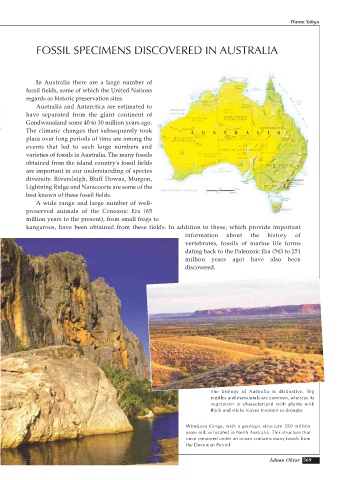
                                                                                                The biology of  Australia is distinctive. Big
                                                                                                reptiles and marsupials are common, whereas its
                                                                                                vegetation is characterized with plants with
                                                                                                thick and sticky leaves resistant to drought.


                                                                                     Windjana Gorge, with a geologic structure 350 million
                                                                                     years old, is located in North Australia. This structure that
                                                                                     once remained under an ocean contains many fossils from
                                                                                     the Devonian Period.


                                                                                                                          Adnan Oktar    569

