


Page 878 - Atlas of Creation Volume 1
P. 878
brain.
                          Nevertheless, the brain perceives sounds most precisely, so that a healthy person's ear hears everything
                     without any atmospheric noise or interference. Your brain is insulated from sound, yet you listen to the sym-
                     phonies of an orchestra, hear all the noises in a crowded auditorium, and perceive all sounds within a wide

                     frequency, from the rustling of leaves to the roar of a jet plane. However, were a sensitive device to measure
                     the sound level in your brain, it would show complete silence prevailing there.
                          Our perception of odour forms in a similar way. Volatile molecules, emitted by vanilla extract or a rose,
                     reach receptors in the delicate hairs in the olfactory epithelium and become involved in an interaction that is

                     transmitted to the brain as electrical signals and perceived as smell. Everything that you smell, be it pleasant
                     or repugnant, is only your brain's perception of the interactions of volatile molecules transformed into elec-
                     trical signals. The scent of a perfume, a flower, any delicious food, the sea, or other odours you like or dislike,
                     you perceive entirely in your brain. The molecules themselves never reach there. Just as with sound and vi-

                     sion, what reaches your sensory centres is simply an assortment of electrical signals. In other words, all the
                     sensations that, since you were born, you've assumed to belong to external objects are just electrical signals
                     interpreted through your sense organs.
                          Similarly, at the front of your tongue, there are four different types of chemical receptors that create the

                     tastes of salty, sweet, sour, and bitter. After a series of chemical processes, your taste receptors transform


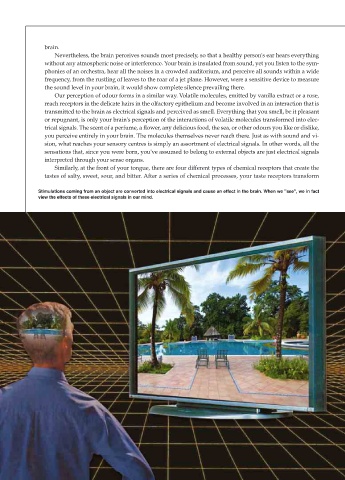
                  Stimulations coming from an object are converted into electrical signals and cause an effect in the brain. When we "see", we in fact
                  view the effects of these electrical signals in our mind.

