


Page 17 - MENU - MARCH / APRIL
P. 17
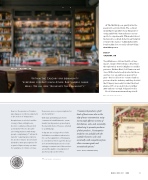
PROOF CALGARY, AB
Within the Calgary bar community “everyone supports each other. Bartenders share ideas...We all seek to elevate the community.”
Even so, the province of Quebec was always a vociferous opponent to the notion of Temperance.
Despite bans on alcohol and the closing of bars selling booze, doctors could prescribe alcohol as medicine! This too became
a booming business with many people complaining of “extraordi- nary ills” requiring prescriptions for alcohol. Ontario doctors were allowed to write prescriptions for a quart of liquor at any one time. For example, in Ontario, in 1923,
there were 600,000 prescriptions for alcohol written!
With laws prohibiting alcohol in commercial establishments, a new market run by women opened up in the back kitchens of houses, referred to as blind pigs.
Today we are seeing echoes of the Prohibition-era debates about alco- hol, as the legalization of marijuana is considered. Heron says the discus- sion around marijuana use in social settings is reminiscent of discussions around the public consumption of alcohol as late as the 1980s.
CONTINUED ON PAGE 18
At The Middle Spoon, quietly utter the password to get into Noble. The cocktail menu  ips frequently to keep things inter- esting and Noble’s bartenders are encour- aged to be experimental. When asked about his favourite cocktail, Doherty can’t help but return to the classics. “A Manhattan with bourbon. My close second is a Tom Collins.” themiddlespoon.ca
PROOF CALGARY, AB
Tony Migliarese tells us that Proof was,
in part, inspired by visiting cocktail bars throughout his travels. Migliarese and his partners, Nathan Head, Je  Jamieson and Jesse Willis, had already worked with one another over an eight-year span in Cal- gary—they’re all service-oriented and ex- perienced in the industry and they decided that Calgary was ready for what they had planned. Proof opened its doors in May 2015 and sure enough, Calgary loved it.
Proof’s  rst menu was made up of well-
CONTINUED ON PAGE 17
“Commercial producers of all kinds of booze were also on the edge of mass consumerism, using increasingly effective systems of distribution, sales, and, eventually, advertising to promote purchases of their products...Consumption tended to rise and fall with the capitalist business cycle, and, eventually, with competition from other consumer goods and recreational options.”
Source: Booze: A Distilled History
MARCH / APRIL 2017
MENU 17


