


Page 26 - BiTS_11_NOVEMBER_2025
P. 26
In November 1961 the regular Straitjackets gig at Jack’s Place came to an end when
    it was burnt to the ground, but they found a new home at the Westmore, and then
    Skyliner Ballroom on Jacksboro Highway. The following year they beat 200 other

    contestants in the regional Coca Cola talent competition, and were placed second in
    the State final.

    At the Skyliner they backed Howlin’ Wolf, Sonny Boy Williamson (and the strippers!),
    and they also worked at clubs in Dallas and Fort Worth (some owned or part-owned

    by Jack Ruby, the killer of Lee Harvey Oswald, the alleged killer of JFK).

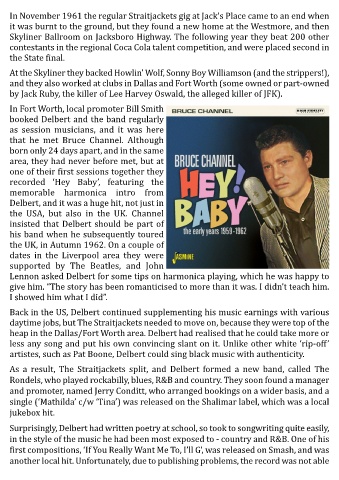
    In Fort Worth, local promoter Bill Smith
    booked Delbert and the band regularly

    as  session  musicians,  and  it  was  here
    that  he  met  Bruce  Channel.  Although
    born only 24 days apart, and in the same
    area, they had never before met, but at

    one of their first sessions together they
    recorded  ‘Hey  Baby’,  featuring  the
    memorable  harmonica  intro  from

    Delbert, and it was a huge hit, not just in
    the  USA,  but  also  in  the  UK.  Channel
    insisted that Delbert should be part of
    his band when he subsequently toured

    the UK, in Autumn 1962. On a couple of
    dates  in  the  Liverpool  area  they  were
    supported  by  The  Beatles,  and  John

    Lennon asked Delbert for some tips on harmonica playing, which he was happy to
    give him. “The story has been romanticised to more than it was. I didn’t teach him.
    I showed him what I did”.


    Back in the US, Delbert continued supplementing his music earnings with various
    daytime jobs, but The Straitjackets needed to move on, because they were top of the
    heap in the Dallas/Fort Worth area. Delbert had realised that he could take more or
    less any song and put his own convincing slant on it. Unlike other white ‘rip-off’

    artistes, such as Pat Boone, Delbert could sing black music with authenticity.

    As  a  result,  The  Straitjackets  split,  and  Delbert  formed  a  new  band,  called  The
    Rondels, who played rockabilly, blues, R&B and country. They soon found a manager

    and promoter, named Jerry Conditt, who arranged bookings on a wider basis, and a
    single (‘Mathilda’ c/w ‘Tina’) was released on the Shalimar label, which was a local

    jukebox hit.

    Surprisingly, Delbert had written poetry at school, so took to songwriting quite easily,
    in the style of the music he had been most exposed to - country and R&B. One of his

    first compositions, ‘If You Really Want Me To, I’ll G’, was released on Smash, and was
    another local hit. Unfortunately, due to publishing problems, the record was not able

