


Page 41 - “O‘ZBEKISTON – 2030 STRATEGIYASI: AMALGA OSHIRILAYOTGAN ISLOHOTLAR TAHLILI, MUAMMOLAR VA YECHIMLAR”
P. 41
suggesting  that  speakers  of  different  languages  may  conceptualize  the  world
            differently  (Whorf,  1956).  Complementing  this  perspective,  Lakoff  and  Johnson’s
            Conceptual  Metaphor  Theory  (1980)  argues  that  humans  comprehend  abstract
            concepts  through  metaphors  grounded  in  physical  and  sensory  experience—for
            example, conceptualizing “economic growth” as “upward movement.”
                   This study aims to investigate how language shapes economic thinking from
            both  cognitive  and  cultural  perspectives.  The  research  specifically  addresses  the
            following questions:
                   How  do  cognitive  linguistic  structures,  particularly  metaphors,  influence
            economic reasoning and behavior?
                   In  what  ways  do  culturally  embedded  linguistic  traditions  shape  the  moral,
            ethical, and emotional dimensions of economic thought?
                   By  examining  both  the  cognitive  mechanisms  and  cultural  frameworks
            embedded  in  language,  this  research  contributes  to  a  deeper  understanding  of
            economic thought, with implications for linguistics, education, and policy-making. It
            highlights  how  linguistic  choices  unconsciously  guide  economic  reasoning,
            emphasizing  the  need  for  critical  awareness  in  both  local  and  global  economic
            contexts.
                   Cultural expressions encode moral attitudes toward wealth. In Uzbek, baraka
            means divine blessing associated with honest work; rizq            implies sustenance granted
            by God. These terms mix spirituality and economics. A person may be “wealthy” yet
            seen as lacking baraka      if perceived as greedy or unjust.

                   In  Chinese,  经济  (jingji) historically  meant  “to  govern  the  household  wisely,”
            linking  economy  to  harmony  and  social  balance.  In  contrast,  English  economic
            discourse  emphasizes  competition,  efficiency,  and  productivity—values  emerging
            from Protestant and capitalist ethics.

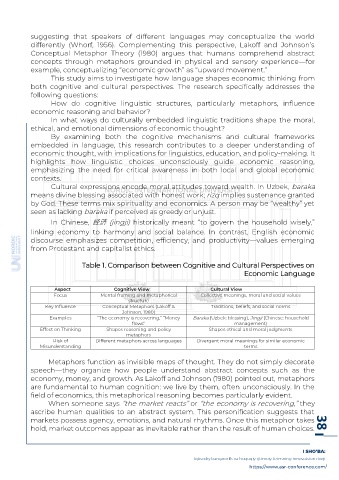
                              Table 1. Comparison between Cognitive and Cultural Perspectives on
                                                                                       Economic Language

                    Aspect               Cognitive View                    Cultural View
                    Focus           Mental framing and metaphorical    Collective meanings, moral and social values
                                              structure
                 Key Influence       Conceptual Metaphors (Lakoff &        Traditions, beliefs, and social norms
                                            Johnson, 1980)
                  Examples         “The economy is recovering,” “Money   Baraka  (Uzbek: blessing), Jingji  (Chinese: household
                                               flows”                              management)
               Effect on Thinking     Shapes reasoning and policy         Shapes ethical and moral judgments
                                             metaphors
                    Risk of        Different metaphors across languages   Divergent moral meanings for similar economic
               Misunderstanding                                                        terms

                  Metaphors function as invisible maps of thought. They do not simply decorate
            speech—they  organize  how  people  understand  abstract  concepts  such  as  the
            economy, money, and growth. As Lakoff and Johnson (1980) pointed out, metaphors
            are fundamental to human cognition: we live by them, often unconsciously. In the
            field of economics, this metaphorical reasoning becomes particularly evident.
                  When someone says “the market reacts”             or “the economy is recovering,”        they
            ascribe  human  qualities  to  an  abstract system.  This  personification  suggests  that
            markets possess agency, emotions, and natural rhythms. Once this metaphor takes
            hold, market outcomes appear as inevitable rather than the result of human choices.                 38


                                                                                                           I SHO‘BA:

                                                                     Iqtisodiy barqarorlik va huquqiy-ijtimoiy tizimning innovatsion rivoji

                                                                                         https://www.asr-conference.com/

