


Page 342 - RAQAMLI TRANSFORMATSIYA DAVRIDA PEDAGOGIK TA’LIMNI RIVOJLANTIRISH ISTIQBOLLARI
P. 342
80
                       60

                       40
                       20

                        0
                              1       2       3       4       5       6      7       8       9       10

                                                     Option "a" (%)  Option "b" (%)


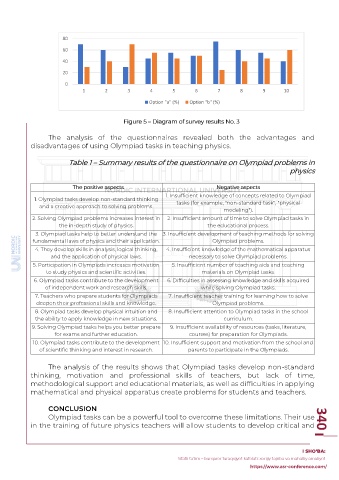
                                            Figure 5 – Diagram of survey results No. 3

                  The  analysis  of  the  questionnaires  revealed  both  the  advantages  and
            disadvantages of using Olympiad tasks in teaching physics.

                         Table 1 – Summary results of the questionnaire on Olympiad problems in
                                                                                                       physics

                           The positive aspects                              Negative aspects
                                                           1. Insufficient knowledge of concepts related to Olympiad
             1. Olympiad tasks develop non-standard thinking   tasks (for example, "non-standard task", "physical
               and a creative approach to solving problems.
                                                                                modeling").
            2. Solving Olympiad problems increases interest in   2. Insufficient amount of time to solve Olympiad tasks in
                      the in-depth study of physics.                      the educational process.
             3. Olympiad tasks help to better understand the  3. Insufficient development of teaching methods for solving
            fundamental laws of physics and their application.              Olympiad problems.
             4. They develop skills in analysis, logical thinking,   4. Insufficient knowledge of the mathematical apparatus
                   and the application of physical laws.           necessary to solve Olympiad problems.
             5. Participation in Olympiads increases motivation   5. Insufficient number of teaching aids and teaching
                 to study physics and scientific activities.            materials on Olympiad tasks.
             6. Olympiad tasks contribute to the development   6. Difficulties in assessing knowledge and skills acquired
                 of independent work and research skills.               while solving Olympiad tasks.
             7. Teachers who prepare students for Olympiads   7. Insufficient teacher training for learning how to solve
              deepen their professional skills and knowledge.               Olympiad problems.
             8. Olympiad tasks develop physical intuition and   8. Insufficient attention to Olympiad tasks in the school
             the ability to apply knowledge in new situations.                  curriculum.
            9. Solving Olympiad tasks helps you better prepare   9. Insufficient availability of resources (tasks, literature,
                    for exams and further education.               courses) for preparation for Olympiads.
             10. Olympiad tasks contribute to the development  10. Insufficient support and motivation from the school and
               of scientific thinking and interest in research.    parents to participate in the Olympiads.

                  The  analysis  of  the  results  shows  that Olympiad  tasks develop  non-standard
            thinking,  motivation  and  professional  skills  of  teachers,  but  lack  of  time,
            methodological support and educational materials, as well as difficulties in applying
            mathematical and physical apparatus create problems for students and teachers.

                  CONCLUSION
                  Olympiad tasks can be a powerful tool to overcome these limitations. Their use                340
            in the training of future physics teachers will allow students to develop critical and


                                                                                                           I SHO‘BA:

                                                               Sifatli ta’lim – barqaror taraqqiyot kafolati: xorijiy tajriba va mahalliy amaliyot

                                                                                         https://www.asr-conference.com/

