


Page 12 - XORIJIY TILLARNI O‘QITISH VA TARJIMA SOHASIDA SUN’IY INTELLEKTDAN SAMARALI FOYDALANISHNING ZAMONAVIY TENDENSIYALARI
P. 12
immigration,  indigenous  languages,  and  frontier  life .  Similarly,  Australian  English
                                                                            4
            incorporates elements derived from Aboriginal languages and colonial experience,
            resulting in a unique set of culturally marked expressions. These variations illustrate
            that dialectal words are not random deviations but systematic reflections of cultural
            adaptation  and  linguistic  evolution.  To  better  illustrate  the  linguocultural
            characteristics  of  dialectal  words,  the  following  table  presents  a  comparative
            overview  of  selected  lexical  items  from  different  English-speaking  countries,
            highlighting their meanings and cultural connotations:

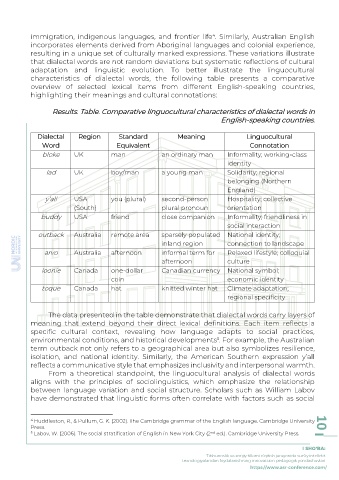
                   Results. Table. Comparative linguocultural characteristics of dialectal words in
                                                                               English-speaking countries.

              Dialectal      Region        Standard            Meaning                  Linguocultural
                Word                      Equivalent                                     Connotation
                bloke      UK           man               an ordinary man        Informality; working-class
                                                                                 identity
                 lad       UK           boy/man           a young man            Solidarity; regional
                                                                                 belonging (Northern
                                                                                 England)
                 y’all     USA          you (plural)      second-person          Hospitality; collective
                           (South)                        plural pronoun         orientation
               buddy       USA          friend            close companion        Informality; friendliness in
                                                                                 social interaction
              outback      Australia    remote area       sparsely populated  National identity;
                                                          inland region          connection to landscape
                 arvo      Australia    afternoon         informal term for      Relaxed lifestyle; colloquial
                                                          afternoon              culture
                loonie     Canada       one-dollar        Canadian currency  National symbol;
                                        coin                                     economic identity
                toque      Canada       hat               knitted winter hat     Climate adaptation;
                                                                                 regional specificity

                  The data presented in the table demonstrate that dialectal words carry layers of
            meaning  that  extend  beyond  their  direct  lexical  definitions.  Each  item  reflects  a
            specific  cultural  context,  revealing  how  language  adapts  to  social  practices,
            environmental conditions, and historical developments . For example, the Australian
                                                                             5
            term outback not only refers to a geographical area but also symbolizes resilience,
            isolation,  and  national  identity.  Similarly,  the  American  Southern  expression  y’all
            reflects a communicative style that emphasizes inclusivity and interpersonal warmth.
                  From  a  theoretical  standpoint,  the  linguocultural  analysis  of  dialectal  words
            aligns  with  the  principles  of  sociolinguistics,  which  emphasize  the  relationship
            between  language  variation  and  social  structure.  Scholars  such  as  William  Labov
            have demonstrated that linguistic forms often correlate with factors such as social


            4  Huddleston, R., & Pullum, G. K. (2002). The Cambridge grammar of the English language. Cambridge University
            Press.                                                                                              10
            5  Labov, W. (2006). The social stratification of English in New York City (2  ed.). Cambridge University Press.
                                                                           nd

                                                                                                           I SHO‘BA:

                                                                         Tilshunoslik va xorijiy tillarni o‘qitish jarayonida sun’iy intellekt
                                                                 texnologiyalaridan foydalanishning innovatsion pedagogik yondashuvlari
                                                                                         https://www.asr-conference.com/

