


Page 154 - XORIJIY TILLARNI O‘QITISH VA TARJIMA SOHASIDA SUN’IY INTELLEKTDAN SAMARALI FOYDALANISHNING ZAMONAVIY TENDENSIYALARI
P. 154
corrective  feedback,  which  allowed  children  to  repeat  and  improve  their
            pronunciation multiple times. The individualized nature of the application enabled
            each child to practice at their own pace. In contrast, the control group continued
            learning  through  traditional  speaking  activities  commonly  used  in  preschool
            classrooms. These activities included songs, flashcards, role-play exercises, repetition
            drills,  and  Total  Physical  Response  techniques.  Teacher  feedback  was  provided
            during classroom interaction, but individual speaking time was naturally limited due
            to the group setting. After the two-week intervention, a posttest was administered
            using the same tasks and evaluation criteria as the pretest. The experimental group
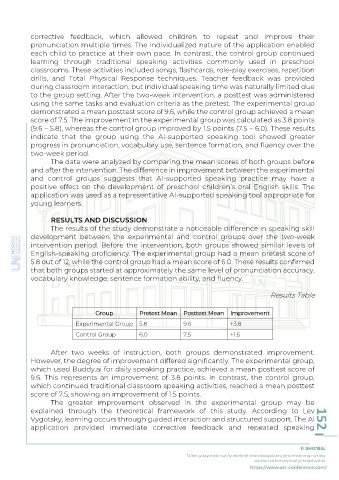
            demonstrated a mean posttest score of 9.6, while the control group achieved a mean
            score of 7.5. The improvement in the experimental group was calculated as 3.8 points
            (9.6 – 5.8), whereas the control group improved by 1.5 points (7.5 – 6.0). These results
            indicate  that  the  group  using  the  AI-supported  speaking  tool  showed  greater
            progress in pronunciation, vocabulary use, sentence formation, and fluency over the
            two-week period.
                   The data were analyzed by comparing the mean scores of both groups before
            and after the intervention. The difference in improvement between the experimental
            and  control  groups  suggests  that  AI-supported  speaking  practice  may  have  a
            positive  effect  on  the  development  of  preschool  children’s  oral  English  skills.  The
            application was used as a representative AI-supported speaking tool appropriate for
            young learners.

                   RESULTS AND DISCUSSION
                   The results of the study demonstrate a noticeable difference in speaking skill
            development  between  the  experimental  and  control  groups  over  the  two-week
            intervention  period.  Before  the  intervention,  both  groups showed  similar  levels  of
            English-speaking proficiency. The experimental group had a mean pretest score of
            5.8 out of 12, while the control group had a mean score of 6.0. These results confirmed
            that both groups started at approximately the same level of pronunciation accuracy,
            vocabulary knowledge, sentence formation ability, and fluency.

                                                                                                Results Table

                                   Group          Pretest Mean  Posttest Mean  Improvement
                            Experimental Group  5.8              9.6              +3.8
                            Control Group         6.0            7.5              +1.5

                   After  two  weeks  of  instruction,  both  groups  demonstrated  improvement.
            However, the degree of improvement differed significantly. The experimental group,
            which used Buddy.ai for daily speaking practice, achieved a mean posttest score of
            9.6.  This  represents  an  improvement  of  3.8  points.  In  contrast,  the  control  group,
            which continued traditional classroom speaking activities, reached a mean posttest
            score of 7.5, showing an improvement of 1.5 points.
                   The  greater  improvement  observed  in  the  experimental  group  may  be
            explained  through  the  theoretical  framework  of  this  study.  According  to  Lev
            Vygotsky, learning occurs through guided interaction and structured support. The AI                 152
            application  provided  immediate  corrective  feedback  and  repeated  speaking


                                                                                                           II SHO‘BA:

                                                                   Ta’lim jarayonida sun’iy intellekt texnologiyalarini joriy etishning nazariy
                                                                                          asoslari va konseptual yondashuvlari
                                                                                         https://www.asr-conference.com/

