


Page 232 - XORIJIY TILLARNI O‘QITISH VA TARJIMA SOHASIDA SUN’IY INTELLEKTDAN SAMARALI FOYDALANISHNING ZAMONAVIY TENDENSIYALARI
P. 232
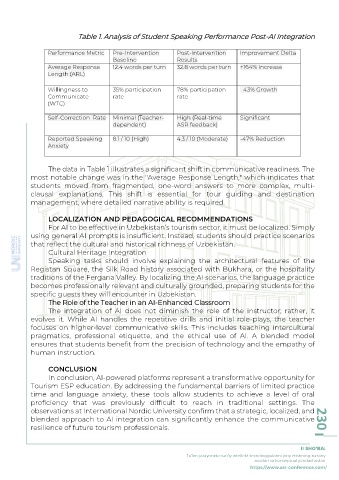
Table 1. Analysis of Student Speaking Performance Post-AI Integration

                  Performance Metric     Pre-Intervention      Post-Intervention     Improvement Delta
                                         Baseline              Results
                  Average Response       12.4 words per turn   32.8 words per turn   +164% Increase
                  Length (ARL)

                  Willingness to         35% participation     78% participation     +43% Growth
                  Communicate            rate                  rate
                  (WTC)

                  Self-Correction  Rate  Minimal (Teacher-     High (Real-time       Significant
                                         dependent)            ASR feedback)

                  Reported Speaking      8.1 / 10 (High)       4.3 / 10 (Moderate)   -47% Reduction
                  Anxiety


                  The data in Table 1 illustrates a significant shift in communicative readiness. The
            most notable change was in the "Average Response Length," which indicates that
            students  moved  from  fragmented,  one-word  answers  to  more  complex,  multi-
            clausal  explanations.  This  shift  is  essential  for  tour  guiding  and  destination
            management, where detailed narrative ability is required.

                  LOCALIZATION AND PEDAGOGICAL RECOMMENDATIONS
                  For AI to be effective in Uzbekistan’s tourism sector, it must be localized. Simply
            using general AI prompts is insufficient. Instead, students should practice scenarios
            that reflect the cultural and historical richness of Uzbekistan.
                  Cultural Heritage Integration
                  Speaking  tasks  should  involve  explaining  the  architectural  features  of  the
            Registan Square,  the  Silk  Road  history associated  with  Bukhara,  or  the  hospitality
            traditions of the Fergana Valley. By localizing the AI scenarios, the language practice
            becomes professionally relevant and culturally grounded, preparing students for the
            specific guests they will encounter in Uzbekistan.
                  The Role of the Teacher in an AI-Enhanced Classroom
                  The  integration  of  AI  does  not  diminish  the  role  of  the  instructor;  rather,  it
            evolves  it.  While  AI  handles  the  repetitive  drills  and  initial  role-plays,  the  teacher
            focuses  on  higher-level  communicative  skills.  This  includes  teaching  intercultural
            pragmatics,  professional  etiquette,  and  the  ethical  use  of  AI.  A  blended  model
            ensures that students benefit from the precision of technology and the empathy of
            human instruction.

                  CONCLUSION
                  In conclusion, AI-powered platforms represent a transformative opportunity for
            Tourism ESP education. By addressing the fundamental barriers of limited practice
            time  and  language  anxiety,  these  tools  allow  students  to  achieve  a  level  of  oral
            proficiency  that  was  previously  difficult  to  reach  in  traditional  settings.  The
            observations at International Nordic University confirm that a strategic, localized, and
            blended approach to AI integration can significantly enhance the communicative                      230
            resilience of future tourism professionals.


                                                                                                           II SHO‘BA:

                                                                   Ta’lim jarayonida sun’iy intellekt texnologiyalarini joriy etishning nazariy
                                                                                          asoslari va konseptual yondashuvlari
                                                                                         https://www.asr-conference.com/

