


Page 26 - XORIJIY TILLARNI O‘QITISH VA TARJIMA SOHASIDA SUN’IY INTELLEKTDAN SAMARALI FOYDALANISHNING ZAMONAVIY TENDENSIYALARI
P. 26
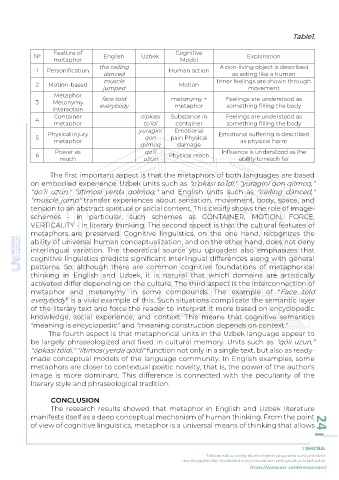
Table1.

                    Feature of                                 Cognitive
             №                       English       Uzbek                                Explanation
                    metaphor                                    Model
                                    the ceiling                               A non-living object is described
              1   Personification                           Human action
                                     danced                                        as acting like a human
                                     muscle                                  Inner feelings are shown through
              2   Motion-based                                  Motion
                                     jumped                                             movement
                    Metaphor
                                     face told
              3     Metonymy        everybody                metonymy +         Feelings are understood as
                                                                                 something filling the body
                                                              metaphor
                   interaction
                    Container                     o‘pkasi    Substance in       Feelings are understood as
             4
                    metaphor                       to‘ldi      container         something filling the body
                                                  yuragini    Emotional
                  Physical injury                                             Emotional suffering is described
              5                                     qon      pain Physical
                    metaphor                                                         as physical harm
                                                  qilmoq       damage
                    Power as                        qo‘li                      Influence is understood as the
              6                                             Physical reach
                      reach                        uzun                              ability to reach far

                   The first important aspect is that the metaphors of both languages are based
            on embodied experience. Uzbek units such as "o’pkasi to’ldi," "yuragini qon qilmoq,"
            "qo’li  uzun,"  "iltimosi  yerda  qolmoq," and  English  units  such  as  "ceiling  danced,"

            "muscle jump" transfer experiences about sensation, movement, body, space, and

            tension to an abstract spiritual or social content. This clearly shows the role of image-
            schemes  -  in  particular,  such  schemes  as  CONTAINER,  MOTION,  FORCE,
            VERTICALITY - in literary thinking. The second aspect is that the cultural features of
            metaphors  are  preserved.  Cognitive  linguistics,  on  the  one  hand,  recognizes  the
            ability of universal human conceptualization, and on the other hand, does not deny
            interlingual  variation.  The  theoretical  source  you  uploaded  also  emphasizes  that
            cognitive linguistics predicts significant interlingual differences along with general
            patterns.  So,  although  there  are  common  cognitive  foundations  of  metaphorical
            thinking  in  English  and  Uzbek,  it  is  natural  that  which  domains  are  artistically
            activated differ depending on the culture. The third aspect is the interconnection of
            metaphor  and  metonymy  in  some  compounds.  The  example  of  "Face  told
            everybody" is a vivid example of this. Such situations complicate the semantic layer
            of the literary text and force the reader to interpret it more based on encyclopedic
            knowledge,  social  experience,  and  context.  This  means  that  cognitive  semantics
            "meaning is encyclopedic" and "meaning construction depends on context."
                  The fourth aspect is that metaphorical units in the Uzbek language appear to
            be largely phraseologized and fixed in cultural memory. Units such as  "qöli uzun,"
            "öpkasi töldi," "iltimosi yerda qoldi"   function not only in a single text, but also as ready-
            made conceptual models of the language community. In English examples, some
            metaphors are closer to contextual poetic novelty, that is, the power of the author's
            image  is  more  dominant.  This  difference  is  connected  with  the  peculiarity  of  the
            literary style and phraseological tradition.

                   CONCLUSION
                   The research results showed that metaphor in English and Uzbek literature
            manifests itself as a deep conceptual mechanism of human thinking. From the point
            of view of cognitive linguistics, metaphor is a universal means of thinking that allows             24


                                                                                                           I SHO‘BA:

                                                                         Tilshunoslik va xorijiy tillarni o‘qitish jarayonida sun’iy intellekt
                                                                 texnologiyalaridan foydalanishning innovatsion pedagogik yondashuvlari
                                                                                         https://www.asr-conference.com/

