


Page 36 - J0JAPS_VOL14
P. 36
Chew Ing Ming  / JOJAPS – JOURNAL ONLINE JARINGAN PENGAJIAN SENI BINA 0194955501


                                (a)                                                                                  (b)
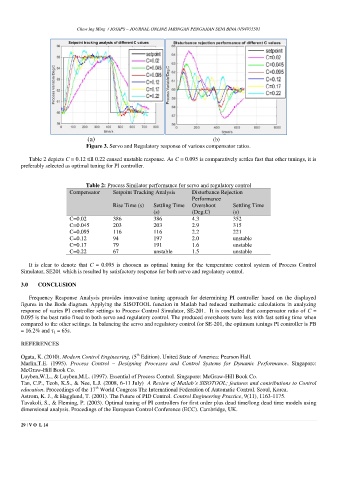
                               Figure 3. Servo and Regulatory response of various compensator ratios.

           Table 2 depicts C = 0.12 till 0.22 caused unstable response. As C = 0.095 is comparatively settles fast that other tunings, it is
        preferably selected as optimal tuning for PI controller.


                               Table 2: Process Similator performance for servo and regulatory control
                         Compensator     Setpoint Tracking Analysis   Disturbance Rejection
                                                                    Performance
                                         Rise Time (s)   Settling Time   Overshoot   Settling Time
                                                       (s)          (Deg.C)        (s)
                         C=0.02          386           386          4.3            352
                         C=0.045         203           203          2.9            315
                         C=0.095         116           116          2.2            221
                         C=0.12          94            197          2.0            unstable
                         C=0.17          79            191          1.6            unstable
                         C=0.22          67            unstable     1.5            unstable

           It  is  clear  to  denote  that  C  =  0.095  is  choosen  as  optimal  tuning  for  the  temperature  control  system  of  Process  Control
        Simulator, SE201 which is resulted by satisfactory response for both servo and regulatory control.

        3.0       CONCLUSION

           Frequency  Response  Analysis  provides  innovative  tuning  approach  for  determining  PI  controller  based  on  the  displayed
        figures in the Bode diagram. Applying the SISOTOOL function in Matlab had reduced mathematic calculations in analyzing
        response of varies PI controller settings to Process Control Simulator, SE-201.  It is concluded that compensator ratio of C =
        0.095 is the best ratio fixed to both servo and regulatory control. The produced overshoots were less with fast setting time when
        compared to the other settings. In balancing the servo and regulatory control for SE-201, the optimum tunings PI controller is PB
        = 16.2% and    = 65s.


        REFERENCES

                                                 th
        Ogata, K. (2010). Modern Control Engineering, (5  Edition). United State of America: Pearson Hall.
        Marlin,T.E.  (1995).  Process  Control  –  Designing  Processes  and  Control  Systems  for  Dynamic  Performance.  Singapore:
        McGraw-Hill Book Co.
        Luyben,W.L., & Luyben,M.L. (1997). Essential of Process Control. Singapore: McGraw-Hill Book Co.
        Tan, C.P., Teoh, K.S., & Nee, L.J. (2008, 6-11 July)  A Review of Matlab’s SISOTOOL; features and contributions to Control
                                   th
        education. Proceedings of the 17  World Congress The International Federation of Automatic Control. Seoul, Korea.
        Astrom, K. J., & Hagglund, T. (2001). The Future of PID Control. Control Engineering Practice, 9(11), 1163-1175.
        Tavakoli, S., & Fleming, P. (2003). Optimal tuning of PI controllers for first order plus dead time/long dead time models using
        dimensional analysis. Procedings of the European Control Conference (ECC). Cambridge, UK.


        29 | V O  L 14

