


Page 62 - J0JAPS_VOL14
P. 62
Aeida Nurhafidzah  / JOJAPS – JOURNAL ONLINE JARINGAN PENGAJIAN SENI BINA 0194955501
           Additionally, modifying the classroom environment may serve as a direct intervention for children who demonstrate ongoing
        disruptive behavior (Conroy, Davis, Fox, and Brown, 2002). Although the well-designed classroom has proven benefits, there is
        little research on the impact environmental modifications have on behavior and learning (Guardino, 2009; Schilling & Shwartz,
        2004.

        3.0 RESEARCH DESIGN AND METHODOLOGY

           This study deployed a survey method to obtain data. The questionnaire instrument contained two sections which was adapted
        from (Pat, n.d.). The first section focused on obtaining respondents’ demographic profiles such as age, semester, gender and
        department of the students.  The second section consists of 21 items of two mainly focussed variables which are the classroom
        physical  appearance  and  classroom  environment.    For  these  21  statements,  this  study  used  a  4-points  Likert  scale  of  1  for
        “strongly agree” to 4 for “strongly disagree”. The questionnaire was developed in English.

           The authors have personally distributed the questionnaires randomly to 338 students of Polytechnic Mukah in July 2017. The
        sample was taken according to the Table for Determining Sample Size from a given Population by Krejcie and Morgan (1970),
        according to Mukah Polytechnic students’ population in June 2017 Session at 2746 students. This study utilized a few common
        statistical tools to analyse the data. SPSS Version 21 was used for this purpose. The reliability tests on the identified variables for
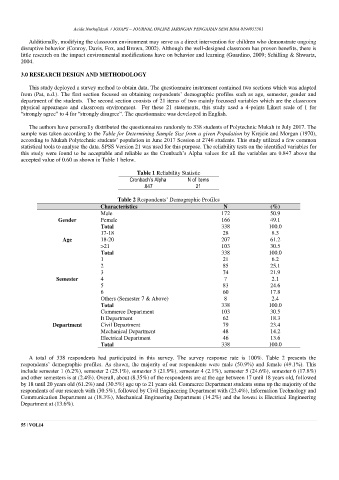
        this study were found to be acceptable and reliable as the  Cronbach’s Alpha values for all the variables are 0.847 above the
        accepted value of 0.60 as shown in Table 1 below.

                                                 Table 1 Reliability Statistic
                                               Cronbach’s Alpha    N of Items
                                                   .847               21

                                          Table 2 Respondents’ Demographic Profiles
                                    Characteristics                             N               (%)
                                    Male                                       172              50.9
                     Gender         Female                                     166              49.1
                                    Total                                      338             100.0
                                    17-18                                      28               8.3
                       Age          18-20                                      207              61.2
                                    >21                                        103              30.5
                                    Total                                      338             100.0
                                    1                                          21               6.2
                                    2                                          85               25.1
                                    3                                          74               21.9
                     Semester       4                                           7               2.1
                                    5                                          83               24.6
                                    6                                          60               17.8
                                    Others (Semester 7 & Above)                 8               2.4
                                    Total                                      338             100.0
                                    Commerce Department                        103              30.5
                                    It Department                              62               18.3
                    Department      Civil Department                           79               23.4
                                    Mechanical Department                      48               14.2
                                    Electrical Department                      46               13.6
                                    Total                                      338             100.0

           A  total  of  338  respondents  had  participated  in  this  survey.  The  survey  response  rate  is  100%.  Table  2  presents  the
        respondents’ demographic profiles. As shown, the majority of our respondents were male (50.9%) and female (49.1%). This
        include semester 1 (6.2%), semester 2 (25.1%), semester 3 (21.9%), semester 4 (2.1%), semester 5 (24.6%), semester 6 (17.8%)
        and other semesters is at (2.4%). Overall, about (8.35%) of the respondents are at the age between 17 until 18 years old, followed
        by 18 until 20 years old (61.2%) and (30.5%) age up to 21 years old. Commerce Department students sums up the majority of the
        respondents of our research with (30.5%), followed by Civil Engineering Department with (23.4%), Information Technology and
        Communication Department at (18.3%), Mechanical Engineering Department (14.2%) and the lowest is Electrical Engineering
        Department at (13.6%).


        55 | VOL14

