


Page 7 - UNI 101 Computer Science Handout.
P. 7
Faculty of Nursing
                                                                  Adult care Nursing Department


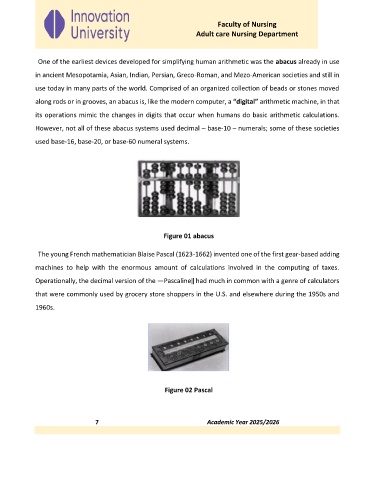
              One of the earliest devices developed for simplifying human arithmetic was the abacus already in use

             in ancient Mesopotamia, Asian, Indian, Persian, Greco-Roman, and Mezo-American societies and still in

             use today in many parts of the world. Comprised of an organized collection of beads or stones moved
             along rods or in grooves, an abacus is, like the modern computer, a “digital” arithmetic machine, in that

             its operations mimic the changes in digits that occur when humans do basic arithmetic calculations.

             However, not all of these abacus systems used decimal – base-10 – numerals; some of these societies
             used base-16, base-20, or base-60 numeral systems.


                                                       Figure 01 abacus


              The young French mathematician Blaise Pascal (1623-1662) invented one of the first gear-based adding
             machines  to  help  with  the  enormous  amount  of  calculations  involved  in  the  computing  of  taxes.

             Operationally, the decimal version of the ―Pascaline‖ had much in common with a genre of calculators

             that were commonly used by grocery store shoppers in the U.S. and elsewhere during the 1950s and

             1960s.


                                                        Figure 02 Pascal


                                 7                                                                        Academic Year 2025/2026

