


Page 130 - Handout Computer Network.
P. 130
•  Checksum—Calculated checksum of the header and data fields

                           •  Urgent Pointer—Indication of the end of the urgent data

                           •  Options—One option currently defined—maximum TCP segment size

                           •  Data—Upper-layer protocol data.

                     6.2.3. UDP


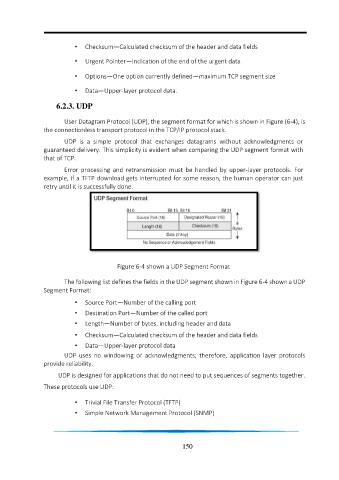
                        User Datagram Protocol (UDP), the segment format for which is shown in Figure (6-4), is
                the connectionless transport protocol in the TCP/IP protocol stack.
                        UDP  is  a  simple  protocol  that  exchanges  datagrams  without  acknowledgments  or
                guaranteed delivery. This simplicity is evident when comparing the UDP segment format with
                that of TCP.

                        Error  processing  and  retransmission  must  be  handled  by  upper-layer  protocols.  For
                example, if a TFTP download gets interrupted for some reason, the human operator can just
                retry until it is successfully done.


                                          Figure 6-4 shown a UDP Segment Format

                        The following list defines the fields in the UDP segment shown in Figure 6-4 shown a UDP
                Segment Format:

                           •  Source Port—Number of the calling port
                           •  Destination Port—Number of the called port
                           •  Length—Number of bytes, including header and data

                           •  Checksum—Calculated checksum of the header and data fields
                           •  Data—Upper-layer protocol data
                        UDP  uses  no  windowing  or  acknowledgments;  therefore,  application  layer  protocols
                provide reliability.

                     UDP is designed for applications that do not need to put sequences of segments together.
                These protocols use UDP:


                           •  Trivial File Transfer Protocol (TFTP)
                           •  Simple Network Management Protocol (SNMP)


                                                                 150

