


Page 65 - Handout Computer Network.
P. 65
Ethernet is the most widely used LAN technology. Ethernet was first implemented by
               a group called DIX (Digital, Intel, and Xerox). DIX created and implemented the first Ethernet
               LAN specification, which was used as the basis for the Institute of Electrical and Electronics
               Engineer  (IEEE)  802.3  specification  released  in  1980.  Later,  the  IEEE  extended  the  802.3
               committee  to  three  new  committees  known  as  802.3u  (Fast  Ethernet),  802.3z  (Gigabit
               Ethernet over Fiber), and 802.3ab (Gigabit Ethernet over UTP). The cabling aspect of the LAN
               exists at Layer 1 of the Open System Interconnection (OSI) reference model. Many topologies
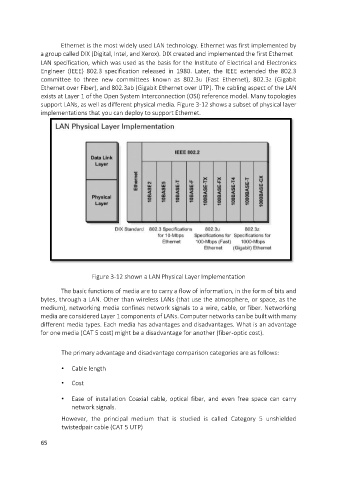
               support LANs, as well as different physical media. Figure 3-12 shows a subset of physical layer
               implementations that you can deploy to support Ethernet.


                                 Figure 3-12 shown a LAN Physical Layer Implementation

                      The basic functions of media are to carry a flow of information, in the form of bits and
               bytes, through a LAN. Other than wireless LANs (that use the atmosphere, or space, as the
               medium), networking media confines network signals to a wire, cable, or fiber. Networking
               media are considered Layer 1 components of LANs. Computer networks can be built with many
               different media types. Each media has advantages and disadvantages. What is an advantage
               for one media (CAT 5 cost) might be a disadvantage for another (fiber-optic cost).


                       The primary advantage and disadvantage comparison categories are as follows:

                       •  Cable length

                       •  Cost


                       •  Ease  of  installation  Coaxial  cable,  optical  fiber,  and  even  free  space  can  carry
                          network signals.
                       However,  the  principal  medium  that  is  studied  is  called  Category  5  unshielded
                       twistedpair cable (CAT 5 UTP)

               65

