


Page 276 - C:\Users\cbaro\OneDrive\Documents\Flip PDF Professional\Study Guide for the Orthopaedic Technology Certification Exams\
P. 276
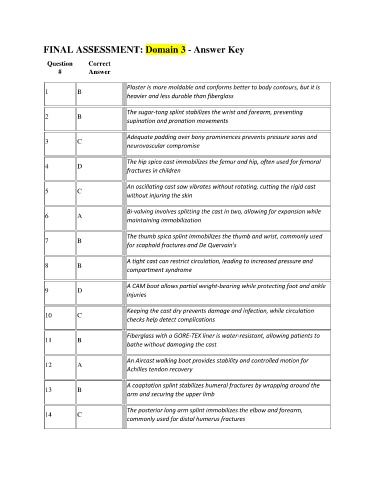
FINAL ASSESSMENT: Domain 3 - Answer Key

                 Question     Correct
                    #         Answer

                                           Plaster is more moldable and conforms better to body contours, but it is
                1          B
                                           heavier and less durable than fiberglass

                                           The sugar-tong splint stabilizes the wrist and forearm, preventing
                2          B
                                           supination and pronation movements


                                           Adequate padding over bony prominences prevents pressure sores and
                3          C
                                           neurovascular compromise

                                           The hip spica cast immobilizes the femur and hip, often used for femoral
                4          D
                                           fractures in children

                                           An oscillating cast saw vibrates without rotating, cutting the rigid cast
                5          C
                                           without injuring the skin

                                           Bi-valving involves splitting the cast in two, allowing for expansion while
                6          A
                                           maintaining immobilization

                                           The thumb spica splint immobilizes the thumb and wrist, commonly used
                7          B
                                           for scaphoid fractures and De Quervain's

                                           A tight cast can restrict circulation, leading to increased pressure and
                8          B
                                           compartment syndrome

                                           A CAM boot allows partial weight-bearing while protecting foot and ankle
                9          D
                                           injuries


                                           Keeping the cast dry prevents damage and infection, while circulation
                10         C
                                           checks help detect complications

                                           Fiberglass with a GORE-TEX liner is water-resistant, allowing patients to
                11         B
                                           bathe without damaging the cast

                                           An Aircast walking boot provides stability and controlled motion for
                12         A
                                           Achilles tendon recovery

                                           A coaptation splint stabilizes humeral fractures by wrapping around the
                13         B
                                           arm and securing the upper limb

                                           The posterior long arm splint immobilizes the elbow and forearm,
                14         C
                                           commonly used for distal humerus fractures

