


Page 248 - Algorithms Notes for Professionals
P. 248
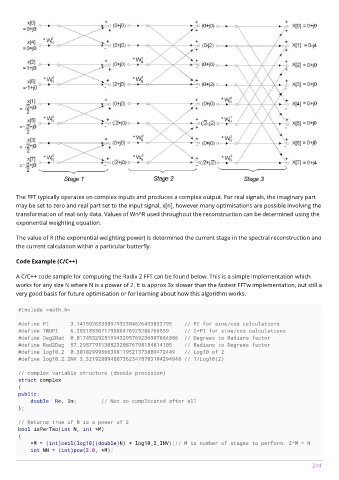
The FFT typically operates on complex inputs and produces a complex output. For real signals, the imaginary part
       may be set to zero and real part set to the input signal, x[n], however many optimisations are possible involving the
       transformation of real-only data. Values of Wn^R used throughout the reconstruction can be determined using the
       exponential weighting equation.

       The value of R (the exponential weighting power) is determined the current stage in the spectral reconstruction and
       the current calculation within a particular butterfly.

       Code Example (C/C++)


       A C/C++ code sample for computing the Radix 2 FFT can be found below. This is a simple implementation which
       works for any size N where N is a power of 2. It is approx 3x slower than the fastest FFTw implementation, but still a
       very good basis for future optimisation or for learning about how this algorithm works.

       #include <math.h>

       #define PI       3.1415926535897932384626433832795    // PI for sine/cos calculations
       #define TWOPI    6.283185307179586476925286766559     // 2*PI for sine/cos calculations
       #define Deg2Rad  0.017453292519943295769236907684886  // Degrees to Radians factor
       #define Rad2Deg  57.295779513082320876798154814105    // Radians to Degrees factor
       #define log10_2  0.30102999566398119521373889472449   // Log10 of 2
       #define log10_2_INV 3.3219280948873623478703194294948 // 1/Log10(2)

       // complex variable structure (double precision)
       struct complex
       {
       public:
           double  Re, Im;        // Not so complicated after all
       };

       // Returns true if N is a power of 2
       bool isPwrTwo(int N, int *M)
       {
           *M = (int)ceil(log10((double)N) * log10_2_INV);// M is number of stages to perform. 2^M = N
           int NN = (int)pow(2.0, *M);

       colegiohispanomexicano.net – Algorithms Notes                                                           244

