


Page 2 - Don Mason, Master Chief, Korean War
P. 2
O V E R V I E W   O F   T H E   K O R E A N   W A R


          On June 25, 1950, the Korean War began when some 75,000 soldiers

          from the North Korean People’s Army poured across the 38th parallel,
          the boundary between the Soviet-backed Democratic People’s Republic

          of Korea to the north and the pro-Western Republic of Korea to the
          south. This invasion was the first military action of the Cold War. By

          July, American troops had entered the war on South Korea’s behalf. As

          far as American officials were concerned, it was a war against the forces
          of international communism itself. After some early back-and-forth

          across the 38th parallel, the fighting stalled and casualties mounted with
          nothing to show for them. Meanwhile, American officials worked

          anxiously to fashion some sort of armistice with the North Koreans. The
          alternative, they feared, would be a wider war with Russia and China–or

          even, as some warned, World War III. Finally, in July 1953, the Korean
          War came to an end.


          THE TWO KOREAS

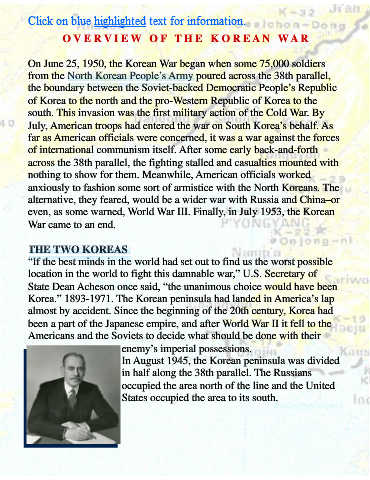
          “If the best minds in the world had set out to find us the worst possible

          location in the world to fight this damnable war,” U.S. Secretary of
          State Dean Acheson once said, “the unanimous choice would have been

          Korea.” 1893-1971. The Korean peninsula had landed in America’s lap
          almost by accident. Since the beginning of the 20th century, Korea had

          been a part of the Japanese empire, and after World War II it fell to the
          Americans and the Soviets to decide what should be done with their

                                         enemy’s imperial possessions.

                                         In August 1945, the Korean peninsula was divided
                                         in half along the 38th parallel. The Russians

                                         occupied the area north of the line and the United
                                         States occupied the area to its south.

