


Page 140 - M. Abrahim Thesis
P. 140
Chapter (3) Networking Media and Data Link Layers Protocols


                        An administrator also can statically assign these directions to the router.


                6.5.2 Static Versus Dynamic Routes

                        Static route knowledge is administered manually by a network administrator who enters
                it into a router’s configuration. The administrator must update this static route entry manually
                whenever  an  internetwork  topology  change  requires  an  update.  Dynamic  route  knowledge
                works  differently.  After  a  network  administrator  enters  configuration  commands  to  start
                dynamic routing, the route knowledge automatically is updated by a routing process whenever
                new information is received from the internetwork.

                        Changes in dynamic knowledge are exchanged between routers as part of the update
                process.


                6.5.3 The Purpose of a Static Route

                       Static routing has several useful applications. Dynamic routing tends to reveal
                everything known about an internetwork; for security reasons, however, you might want to
                hide parts of an internetwork. Static routing enables you to specify the information that you
                want to reveal about restricted networks. When a network is accessible by only one path, a
                static route to the network can be sufficient. This type of network is called a stub network.

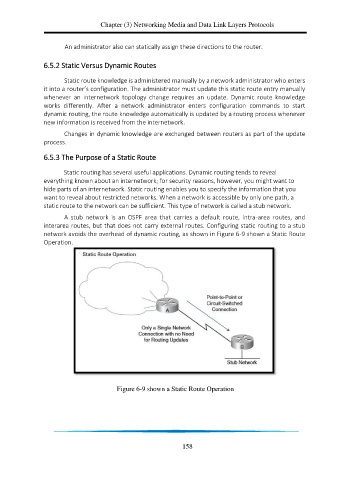
                        A  stub  network  is  an  OSPF  area  that  carries  a  default  route,  intra-area  routes,  and
                interarea routes, but that does not carry external routes. Configuring static routing to a stub
                network avoids the overhead of dynamic routing, as shown in Figure 6-9 shown a Static Route
                Operation.


                                          Figure  6 - 9  shown a Static Route Operation


                                                                 158

