


Page 217 - M. Abrahim Thesis
P. 217
Computer Network                                                             2026


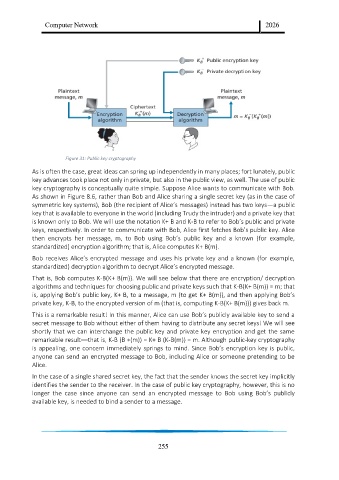
                        Figure 31: Public key cryptography

            As is often the case, great ideas can spring up independently in many places; fort lunately, public
            key advances took place not only in private, but also in the public view, as well. The use of public
            key cryptography is conceptually quite simple. Suppose Alice wants to communicate with Bob.
            As shown in Figure 8.6, rather than Bob and Alice sharing a single secret key (as in the case of
            symmetric key systems), Bob (the recipient of Alice’s messages) instead has two keys—a public
            key that is available to everyone in the world (including Trudy the intruder) and a private key that
            is known only to Bob. We will use the notation K+ B and K-B to refer to Bob’s public and private
            keys, respectively. In order to communicate with Bob, Alice first fetches Bob’s public key. Alice
            then  encrypts  her  message,  m,  to  Bob  using  Bob’s  public  key  and  a  known  (for  example,
            standardized) encryption algorithm; that is, Alice computes K+ B(m).

            Bob receives Alice’s encrypted message and uses his private key and a known (for example,
            standardized) decryption algorithm to decrypt Alice’s encrypted message.
            That is, Bob computes K-B(K+ B(m)). We will see below that there are encryption/ decryption
            algorithms and techniques for choosing public and private keys such that K-B(K+ B(m)) = m; that
            is, applying Bob’s public key, K+ B, to a message, m (to get K+ B(m)), and then applying Bob’s
            private key, K-B, to the encrypted version of m (that is, computing K-B(K+ B(m))) gives back m.
            This is a remarkable result! In this manner, Alice can use Bob’s publicly available key to send a
            secret message to Bob without either of them having to distribute any secret keys! We will see
            shortly that we can interchange the public key and private key encryption and get the same
            remarkable result––that is, K-B (B +(m)) = K+ B (K-B(m)) = m. Although public-key cryptography
            is appealing, one concern immediately springs to mind. Since Bob’s encryption key is public,
            anyone can send an encrypted message to Bob, including Alice or someone pretending to be
            Alice.

            In the case of a single shared secret key, the fact that the sender knows the secret key implicitly
            identifies the sender to the receiver. In the case of public key cryptography, however, this is no
            longer  the  case  since  anyone  can  send  an  encrypted  message  to  Bob  using  Bob’s  publicly
            available key, is needed to bind a sender to a message.


                                                         255

