


Page 16 - RJLJS - Legacy Program Black Version 2
P. 16
on a documentary for Britain’s Channel 4 network, who                   Rainbow PUSH and the Family Legacy
                                                              were being held in Liberia. He traveled extensively in the
                                                              Middle East and Asia and was a special guest of President
                                                              Fernando Cardoso of Brazil to honor Zumbi, the leader                        uring Reverend Jackson’s visit to Memphis, he
                                                              of slave revolts that led to the end of slavery in Brazil.              Dspent meaningful time at the home of Reverend
                                                                                                                                      Samuel “Billy” Kyles and his wife, Gwen Kyles, where
                                                              On November 2, 1985, Reverend Jackson joined the                        a simple gathering by the pool became a meeting of
                                                              120,000-strong demonstration in London’s Trafalgar                      minds and purpose. In that moment of fellowship, ideas
                                                              Square to protest apartheid in South Africa. He declared                flowed about how to strengthen Operation Breadbasket,
                                                              South Africa to be “a moral disgrace” and called for                    deepen its economic impact, and mobilize communities
                                                              divestment in the Apartheid nation and for the South                    around justice and opportunity. The Kyles family offered
                                                              African government to free Nelson Mandela.                              not only their home but their unwavering commitment
                                                                                                                                      to the movement—creating a space where faith met
                                                              Rev. Jackson’s global appeal against Apartheid helped                   strategy, and vision met action. It was in moments like
                                                              ignite the Free South Africa Movement of that decade.                   these, marked by sincerity and shared conviction, that
                                                              In February 1990, Jackson was among the first to greet                  the seeds of enduring social change were planted and
                                                              Mandela as he emerged from Victor Verster prison.                       PUSH was born.

                                                              At home as abroad, Jackson was not afraid to call out                   From its earliest days, PUSH served as a platform for
                                                              what he considered his own country’s international sins.                empowerment and education. It urged African Americans to build economic strength, to buy Black, to bank Black,
                                                              On February 16, 2003, Rev. Jackson gave the keynote                     and to believe in the power of unity. Reverend Jackson’s message was clear: self-help and social justice were not
                                                              address at a rally in London’s Hyde Park attended by over               opposing ideals—they were partners in liberation.
                                                              1 million people protesting the expected invasion of Iraq
                                                              by the United States.                                                   In 1975, the organization launched PUSH-Excel, an educational initiative that encouraged young people to
                                                                                                                                      pledge to academic discipline and personal excellence. “If my mind can conceive it, and my heart can believe it,
                                                              In August 2007, Equanomics—UK invited Rev. Jackson                      I can achieve it,” became a rallying cry in classrooms across America. Supported by the President Jimmy Carter
                                                              to help launch the new organization in a historic nine-                 Administration, PUSH-Excel transformed communities by instilling hope, responsibility, and discipline in the lives
                                                              city UK tour. It coincided with the 200th anniversary                   of thousands of students.
                                                              of the abolition of the Slave Trade Act in Britain. At the
                                                              conclusion of the tour, Rev. Jackson joined international               By 1984, as the moral and political landscape shifted, Reverend Jackson broadened his vision from economic
                                                              dignitaries in the unveiling of the statue of Nelson                    inclusion to political empowerment. During his historic presidential campaign, he founded the National Rainbow
                                                              Mandela in London’s Parliament Square.                                  Coalition, an alliance of Americans of every race, faith, and background—bound together by a shared belief in
                                                                                                                                      justice and opportunity for all.
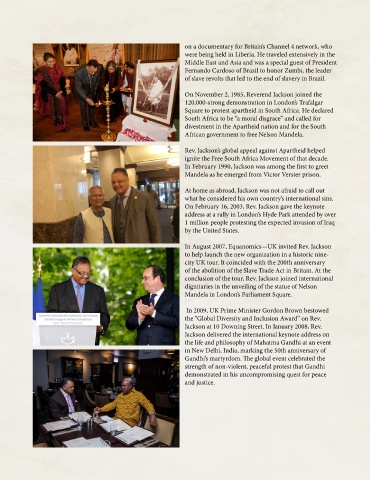
                                                               In 2009, UK Prime Minister Gordon Brown bestowed
                                                              the “Global Diversity and Inclusion Award” on Rev.
                                                              Jackson at 10 Downing Street. In January 2008, Rev.
                                                              Jackson delivered the international keynote address on
                                                              the life and philosophy of Mahatma Gandhi at an event
                                                              in New Delhi, India, marking the 50th anniversary of
                                                              Gandhi’s martyrdom. The global event celebrated the
                                                              strength of non-violent, peaceful protest that Gandhi
                                                              demonstrated in his uncompromising quest for peace
                                                              and justice.

