


Page 12 - demo
P. 12
Portable Ladder Safety

        Falls from portable ladders (step, straight, combination and
        extension) are one of the leading causes of occupational
        fatalities and injuries.
          •  Read and follow all labels/markings on the ladder.
          •  Avoid electrical hazards! – Look for overhead power lines before
            handling a ladder. Avoid using a metal ladder near power lines or
            exposed energized electrical equipment.
          •  Always inspect the ladder prior to using it. If the ladder is damaged, it
            must be removed from service and tagged until repaired or discarded.
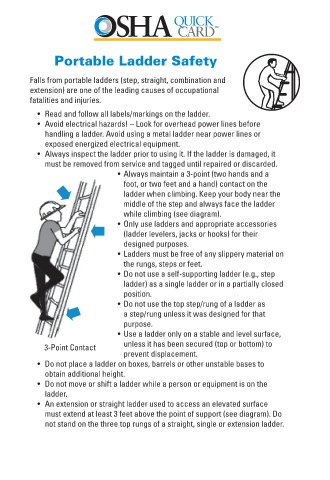
                             •  Always maintain a 3-point (two hands and a
                               foot, or two feet and a hand) contact on the
                               ladder when climbing. Keep your body near the
                               middle of the step and always face the ladder
                               while climbing (see diagram).
                             •  Only use ladders and appropriate accessories
                               (ladder levelers, jacks or hooks) for their
                               designed purposes.
                             •  Ladders must be free of any slippery material on
                               the rungs, steps or feet.
                             •  Do not use a self-supporting ladder (e.g., step
                               ladder) as a single ladder or in a partially closed
                               position.
                             •  Do not use the top step/rung of a ladder as
                               a step/rung unless it was designed for that
                               purpose.
                             •  Use a ladder only on a stable and level surface,
            3-Point Contact    unless it has been secured (top or bottom) to
                               prevent displacement.
          •  Do not place a ladder on boxes, barrels or other unstable bases to
            obtain additional height.
          •  Do not move or shift a ladder while a person or equipment is on the
            ladder.
          •  An extension or straight ladder used to access an elevated surface
            must extend at least 3 feet above the point of support (see diagram). Do
            not stand on the three top rungs of a straight, single or extension ladder.

