


Page 4 - demo
P. 4
All-terrain Vehicle (ATV)
                          Safety at Work


               Facts Related to ATV Crashes and Injures at Work1
          •  Males are at a much higher risk
          •  Workers 65 years of age or older are at higher risk than younger
            workers
          •  Rollovers are the most common cause of crashes
          •  Animal production workers have the highest risk for injury
        Background
        ATVs were first introduced in the U.S. for agricultural use in the early
        1980s. Over the past thirty years, ATVs have grown increasingly popular
        recreationally, and more recently have become a valuable asset at work.
        With more than 10 million in use, it is important to know the hazards
        associated with ATVs and how to operate them safely. 1,2

        Recommended Practices for the Safe Use of ATVs at Work  3-5
                                For Employees
          •  Refer to specific ATV/UTV User Manual for proper operation and
            inspection procedures.
          •  Employees operating an ATV need to wear a helmet.  UTV operators and
            passengers are required to wear a seat belt during operation.
          •  Any damage to an ATV or UTV should be reported to your supervisor
            immediately.  The vehicle should be inspected thoroughly to evaluate if
            it can be safely operated or not.
          •  Understand how implements and attachments may affect the stability
            and handling of the ATV
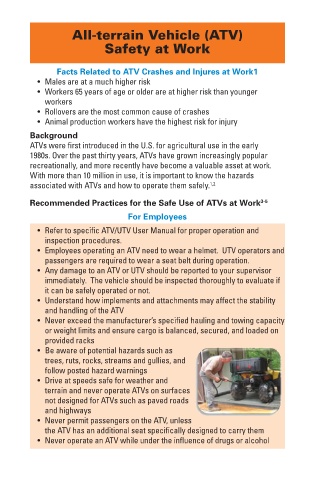
          •  Never exceed the manufacturer’s specified hauling and towing capacity
            or weight limits and ensure cargo is balanced, secured, and loaded on
            provided racks
          •  Be aware of potential hazards such as
            trees, ruts, rocks, streams and gullies, and
            follow posted hazard warnings
          •  Drive at speeds safe for weather and
            terrain and never operate ATVs on surfaces
            not designed for ATVs such as paved roads
            and highways
          •  Never permit passengers on the ATV, unless
            the ATV has an additional seat specifically designed to carry them
          •  Never operate an ATV while under the influence of drugs or alcohol

