


Page 142 - 2019 September 10th Sotheby's Important Chinese Art Jades, Met Museum Irving Collection NYC
P. 142
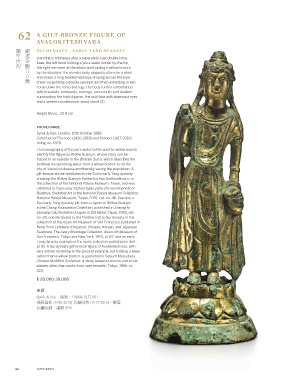
62      A GILT-BRONZE FIGURE OF
                AVALOKITESHVARA
       昳   戭    SUI DYNASTY - EARLY TANG DYNASTY
       军   挷    standing in tribhanga atop a separately-cast double-lotus
       Ⓒ   慹    base, the left hand holding a ‘pure water bottle’ by the hip,
       ⇅ġġġ  奨  the right arm bent at the elbow and holding a willow branch
           枛    by the shoulder, the slender body elegantly attired in a dhoti
           䩳    and shawl, a long beaded necklace draping across the bare
           ⁷    chest suspending a double-pendant and then extending in two
                cords down the torso and legs, the body further embellished
                with bracelets, armbands, earrings, and a multi-part diadem
                surrounding the high chignon, the oval face with downcast eyes
                and a serene countenance, wood stand (3)

                Height 8¼ in., 20.8 cm


                PROVENANCE
                Spink & Son, London, 10th October 1988.
                Collection of Florence (1920-2018) and Herbert (1917-2016)
                Irving, no. 1970.
                The iconography of the pure water bottle and the willow branch
                identify this Þ gure as Willow Guanyin, whose story can be
                traced to an episode in the Dharani Sutra, which describes the
                bodhisattva sprinkling water from a willow branch to rid the
                city of Vaisali of disease and thereby saving the population. A
                gilt-bronze shrine attributed to the Sui to early Tang dynasty
                showing the Willow Guanyin ß anked by two bodhisattvas is in
                the collection of the National Palace Museum, Taipei, and was
                exhibited in Yuan cang Yazhou fojiao yishu zhi mei/Imprints of
                Buddhas: Buddhist Art in the National Palace Museum Collection,
                National Palace Museum, Taipei, 2015, cat. no. 48. See also a
                Sui/early Tang dynasty gilt-bronze Þ gure of Willow Guanyin
                in the Chang Foundation Collection, published in Jintong fo
                zaoxiang tulu/Buddhist Images in Gilt Metal, Taipei, 1993, cat.
                no. 28; one attributed to the Northern Qi to Sui dynasty in the
                collection of the Asian Art Museum of San Francisco published in
                René-Yvon Lefebvre d’Argencé, Chinese, Korean, and Japanese
                Sculpture: The Avery Brundage Collection, Asian Art Museum of
                San Francisco, Tokyo and New York, 1974, pl. 67; and an early
                Tang dynasty example in the same collection published in ibid.,
                pl. 81. A Sui dynasty gilt-bronze Þ gure of Avalokiteshvara, with
                very similar modeling to the present example, but holding a jewel
                rather than a willow branch, is published in Saburō Matsubara,
                Chinese Buddhist Sculpture: A study based on bronze and stone
                statues other than works from cave temples, Tokyo, 1966, pl.
                223.
                $ 20,000-30,000
                Ը๕
                ŔűŪůŬġħġŔŰů炻ΐ㔎炻IJĺĹĹ⸜IJı㚰IJı㖍
                ἃ伭ΐ㕗ġĩIJĺijıĮijıIJĹĪġ⍲崓ỗ䈡ġĩIJĺIJĸĮijıIJķĪɀ㫸暚
                ằ⃟㓞啷炻䶐嘇IJĺĸı


       140      SOTHEBY’S

