


Page 26 - 2020 September 21 Elegant Embellishment the RenLu Colelction, Bonham NYC
P. 26
319
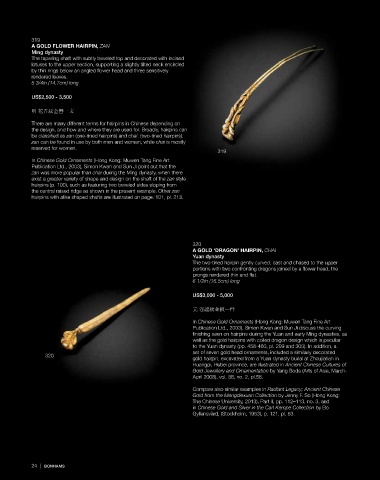
           A GOLD FLOWER HAIRPIN, ZAN
           Ming dynasty
           The tapering shaft with subtly beveled top and decorated with incised
           lotuses to the upper section, supporting a slightly tilted neck encircled
           by thin rings below an angled flower head and three sensitively
           rendered leaves.
           5 3/4in (14.7cm) long

           US$2,500 - 3,500

           明 花卉紋金簪一支

           There are many different terms for hairpins in Chinese depending on
           the design, and how and where they are used for. Broadly, hairpins can
           be classified as zan (one-tined hairpins) and chai. (two-tined hairpins).
           zan can be found in use by both men and women, while chai is mostly
           reserved for women.                                       319

           In Chinese Gold Ornaments (Hong Kong: Muwen Tang Fine Art
           Publication Ltd., 2003), Simon Kwan and Sun Ji point out that the
           zan was more popular than chai during the Ming dynasty, when there
           exist a greater variety of shape and design on the shaft of the zan style
           hairpins (p. 100), such as featuring two beveled sides sloping from
           the central raised ridge as shown in the present example. Other zan
           hairpins with alike shaped shafts are illustrated on page. 101, pl. 213.


                                                             320
                                                             A GOLD ‘DRAGON’ HAIRPIN, CHAI
                                                             Yuan dynasty
                                                             The two-tined hairpin gently curved, cast and chased to the upper
                                                             portions with two confronting dragons joined by a flower head, the
                                                             prongs rendered thin and flat.
                                                             6 1/2in (16.5cm) long

                                                             US$3,000 - 5,000

                                                             元 卷龍紋金釵一件

                                                             In Chinese Gold Ornaments (Hong Kong: Muwen Tang Fine Art
                                                             Publication Ltd., 2003), Simon Kwan and Sun Ji discuss the curving
                                                             finishing seen on hairpins during the Yuan and early Ming dynasties, as
                                                             well as the gold hairpins with coiled dragon design which is peculiar
                                                             to the Yuan dynasty (pp. 458-460, pl. 299 and 300). In addition, a
                                                             set of seven gold head ornaments, included a similarly decorated
               320                                           gold hairpin, excavated from a Yuan dynasty burial at Zhoujiatian in
                                                             Huangpi, Hubei province, are illustrated in Ancient Chinese Cultures of
                                                             Gold Jewellery and Ornamentation by Yang Boda (Arts of Asia, March-
                                                             April 2008), vol. 38, no. 2, pl.58.

                                                             Compare also similar examples in Radiant Legacy; Ancient Chinese
                                                             Gold from the Mengdiexuan Collection by Jenny F. So (Hong Kong:
                                                             The Chinese University, 2013), Part II, pp. 112–113, no. 3, and
                                                             in Chinese Gold and Silver in the Carl Kempe Collection by Bo
                                                             Gyllensvärd, (Stockholm, 1953), p. 121, pl. 63.


           24  |  BONHAMS

