


Page 32 - 2020 September 21 Elegant Embellishment the RenLu Colelction, Bonham NYC
P. 32
328


           328
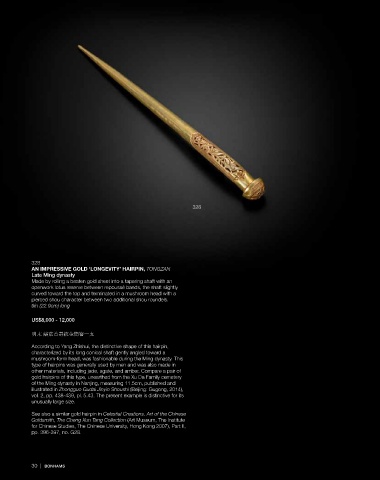
           AN IMPRESSIVE GOLD ‘LONGEVITY’ HAIRPIN, TONGZAN
           Late Ming dynasty
           Made by rolling a beaten gold sheet into a tapering shaft with an
           openwork lotus reserve between repoussé bands, the shaft slightly
           curved toward the top and terminated in a mushroom head with a
           pierced shou character between two additional shou roundels.
           9in (22.9cm) long

           US$8,000 - 12,000
           明末 蘑菇首壽紋金筒簪一支

           According to Yang Zhishui, the distinctive shape of this hairpin,
           characterized by its long conical shaft gently angled toward a
           mushroom-form head, was fashionable during the Ming dynasty. This
           type of hairpins was generally used by men and was also made in
           other materials, including jade, agate, and amber. Compare a pair of
           gold hairpins of this type, unearthed from the Xu Da Family cemetery
           of the Ming dynasty in Nanjing, measuring 11.5cm, published and
           illustrated in Zhongguo Gudai Jinyin Shoushi (Beijing: Gugong, 2014),
           vol. 2, pp. 438-439, pl. 5.43. The present example is distinctive for its
           unusually large size.

           See also a similar gold hairpin in Celestial Creations. Art of the Chinese
           Goldsmith, The Cheng Xun Tang Collection (Art Museum, The Institute
           for Chinese Studies, The Chinese University, Hong Kong 2007), Part II,
           pp. 396-397, no. G28.


           30  |  BONHAMS

