


Page 120 - 2019 September 9th Bonhams Important Chinese Works of Art
P. 120
PROPERTY OF VARIOUS OWNERS
                                                             920
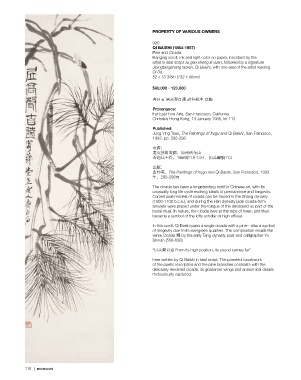
                                                             QI BAISHI (1864-1957)
                                                             Pine and Cicada
                                                             Hanging scroll, ink and light color on paper, inscribed by the
                                                             artist in seal script Ju gao sheng zi yuan, followed by a signature
                                                             Jipingtangshang laoren, Qi Baishi, with one seal of the artist reading
                                                             Qi Da.
                                                             52 x 13 3/8in (132 x 40cm)

                                                             $80,000 - 120,000

                                                             齊白石 居高聲自遠 設色紙本 立軸

                                                             Provenance:
                                                             Far East Fine Arts, San Francisco, California
                                                             Christie’s Hong Kong, 13 January 1986, lot 113

                                                             Published:
                                                             Jung Ying Tsao, The Paintings of Xugu and Qi Baishi, San Francisco,
                                                             1993, pp. 295-298

                                                             來源:
                                                             遠東藝術畫廊,加州舊金山
                                                             香港佳士得,1986年1月13日,拍品編號113

                                                             出版:
                                                             曹仲英,The Paintings of Xugu and Qi Baishi, San Francisco, 1993
                                                             年,295-298頁

                                                             The cicada has been a longstanding motif in Chinese art, with its
                                                             unusually long life cycle evoking ideals of permanence and longevity.
                                                             Carved jade models of cicada can be traced to the Shang dynasty
                                                             (1600-1100 b.c.e.), and during the Han dynasty jade cicada-form
                                                             amulets were placed under the tongue of the deceased as part of the
                                                             burial ritual. In nature, the cicada lives at the tops of trees, and thus
                                                             became a symbol of the lofty scholar or high official.

                                                             In this scroll, Qi Baishi pairs a single cicada with a pine-- also a symbol
                                                             of longevity due to its evergreen qualities. The composition recalls the
                                                             verse Cicada 蟬 by the early Tang dynasty poet and calligrapher Yu
                                                             Shinan (558-638)

                                                             “居高聲自遠 From its high position, its sound carries far”

                                                             here written by Qi Baishi in seal script. The powerful brushwork
                                                             of the poetic inscription and the pine branches contrasts with the
                                                             delicately rendered cicada, its gossamer wings and anatomical details
                                                             meticulously captured.


           118  |  BONHAMS

