


Page 52 - Chinese Decorative Arts: The Metropolitan Museum of Art Bulletin, v. 55, no. 1 (Summer, 1997)
P. 52
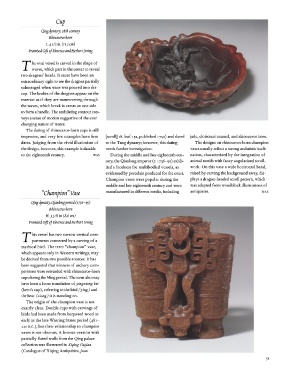
Cup

                            i8th
                   Qing dynasty,  century
                      Rhinoceros horn
                     L.  41/2  in.  (11.2 cm)
                             and Herbert
             Promised  Gift  ofFlorence   Irving
               he  oval  vessel is carved  in  the  shape  of
               waves,  which  part  in  the center  to reveal
                    heads.  It must  have been an
          two  dragons'
          extraordinary sight  to see the  dragons partially
                   when wine  was
          submerged            poured  into the
                                       on the
          cup.  The  bodies of the  dragons  appear
          exterior as  if  they  are  maneuvering through
          the  waves,  which  break in crests on one side
                                  contour con-
          to form a handle. The  undulating
                                   of the ever
          veys  a sense of motion  suggestive
                 nature  of water.
          changing
            The  dating  of rhinoceros-horn  is still
                                   cups
                  and
                                    have  firm
          imprecise,   very  few  examples    [scroll]  I8,  leaf  Isa, published  1750)  and dated   jade,  cloisonne  enamel,  and rhinoceros horn.
          dates.  Judging  from the vivid illusionism  of   to the  Tang dynasty;  however,  this  dating   The  designs  on rhinoceros-horn  champion
          the  design,  however,  this  example   needs further  investigation.   vases  usually  reflect  a  strong  archaistic incli-
                                   is datable
          to the  eighteenth  century.   WAS    During  the middle and late  eighteenth  cen-   nation,  characterized  by  the  integration  of
                                              tury,  the  Qianlong  emperor  (r. 1736-95)  exhib-   animal motifs  with  fancy angularized  scroll-
                                              ited  a fondness for multibodied  vessels,  as   work. On this vase a wide horizontal  band,
                                              evidenced  by porcelain produced  for the court.   raised  by carving  the  background away,  dis-
                                                                                      a
                                              Champion  vases were  popular during  the   plays  dragon-headed  scroll  pattern,  which
                                              middle and late  eighteenth century  and were   was  adapted  from  woodblock illustrations of
                                              manufactured  in different  media,  including   antiquities.      WAS
                   "champion"vase
          ....................................................................................
              Qing dynasty,      (1736-95)
                       Qianlongperiod
                             horn
                      Rhinoceros
                    H.  3 3/8  in.  (8.6 cm)
                             and  Herbert
             Promised  Gift  ofFlorence   Irving
               his vessel has two narrow vertical com-
                      connected  a
                                        of a
               partments      by  carving
                 bird.  The term
          mythical           "champion"  vase,
          which  appears  only  in Western
                                 writings, may
          be derived  from two  possible
                                sources. It has
          been  suggested        archery
                                       com-
                      that  winners  of
                 were rewarded with rhinoceros-horn
          petitions
                   the
                              The term  also
          cups  during  Ming period.    may
          have been  a loose translation of  yingxiong
                                         bei
                           to the  bird
          (hero's  cup),  referring   (ying)  and
          the bear  (xiong)  it is  standing
                                on.
            The  origin  of the  champion
                                 vase is not
                clear. Double
          exactly          cups  with  carvings  of
          birds had been made  from  lacquered
                                     wood as
          early  as the late  Warring  States  period (48I-
          22I  B.C.),  but  their  relationship  champion
                                  to
          vases  is not obvious.  A bronze version with
          partially  fluted  walls from the  Qing palace
          collection  was illustrated  in  Xiqing  Gujian
                   of
          (Catalogue  Xiqing Antiquities,juan
                                                                                                                  5I

