


Page 4 - AfrOil Week 47 2019
P. 4
AfrOil COMMENTARY AfrOil
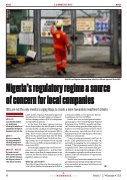
Both IOCs and Nigerian companies have called for a different approach (Photo: ANP)
Nigeria’s regulatory regime a source
of concern for local companies
IOCs are not the only investors urging Abuja to create a more favourable investment climate
WHAT:
Local business leaders are speaking out following the adoption of amendments to Nigeria’s deepwater contracts law.
WHY:
Worries are mounting that the government is not doing enough to at- tract and retain investors.
WHAT NEXT:
The head of a local oilfield service provider fears that IOCs may pass over Nigeria in favour of other African countries.
LAST month, Nigeria’s Parliament approved amendments to the legal regime covering pro- duction-sharingcontracts(PSCs)fordeepwater and inland basin projects.
At the time, this move spurred concern about the possibility that Abuja’s push to secure more favourable conditions for itself might end up driving international oil companies (IOCs) away. These worries did not seem misplaced, given that the government had cited the Deep Offshore and Inland Basin Production-Shar- ing Contract Act as justification for its ongoing efforts to recover $62bn in purportedly lost rev- enues from IOCs.
Now, though, it appears that some local com- panies are also apprehensive – and that their fears stem not just from the amendments to the contract law but also from deficiencies in the regulatory regime as a whole.
Wake-up call needed?
One of the oil executives who has expressed con- cern is Diran Fawibe, the chairman and CEO of
a domestic oilfield service provider, Interna- tional Energy Services Ltd (IESL).
Fawibe,whoonceservedasgeneralmarket- ing manager at state-owned Nigerian National Petroleum Corp. (NNPC), recently told Nige- ria’s Guardian newspaper that Abuja ought to try harder to woo IOCs and other investors. More effort is necessary, especially now that new oil and gas provinces are opening up in other parts of Africa, he commented.
“I am not saying government could not do much. [The] government needs to wake up, especially in engaging the oil companies,” he warned. “[The] government needs to draw the companies closer. There is [a] need for [the] gov- ernment to continuously have dialogue with the oil companies, especially now that there is com- petition. There are other places of opportunity for investment.”
The IESL chief noted that a number of oil and
gas operators had already exited Nigeria because
of concerns about government interference and regulatory confusion
P4
w w w . N E W S B A S E . c o m Week 47 27•November•2019


