Page 100 - Empowerment and Protection - Stories of Human Security
P. 100
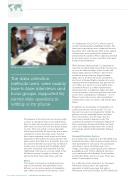
MEND focus group in Ramallah, OPT
The data collection methods used, were mainly face-to-face interviews and focus groups, supported by survey-style questions in writing or by phone.
The purpose of the interviews was to give people
a chance to talk about what is most important to them, to share their perspectives or stories, and to allow them to freely state how they define human security. They were asked a series of questions which tried to identify the issues they saw as main contributors to their insecurity, where they felt these issues originated, which issues are the most important in driving their insecurity and how that played out in their daily lives. In contrast, they were also asked to identify local issues that contributed to their sense of security and to highlight which ones they considered most important and why. Additionally, interviewees were also asked if they felt that one group of people or ethnicity was affected by them more than others, and why.
Mexico
This chapter was based on in-depth interviews and/or conversations with stakeholders from different sectors, and an analysis of stakeholder and conflict assessments carried out by Centro
de Colaboración Cívica (CCC), which is part of several international peacebuilding networks. The interviews/conversations were conducted between December 2013 and February 2014 by the authors. All interviews were conducted in Spanish and translated by the authors. When explicitly permitted by the interviewees, we have used their real names and personal information.
While having a limited sample, it is important to note that we intentionally selected the interviewees, to cover the different angles of the security and human rights situation in Mexico. Interviewees include an attorney that has litigated human
rights cases in the Inter-American Commission
and Court of Human Rights; members of several nongovernmental organisations that promote the use of bikes as a means to recover public space
in northern Mexico; a conflict transformation professional close to indigenous rights and other social movements; a university professor and social activist from Ciudad Juárez, Chihuahua – one of Mexico’s most violent cities; and a psychologist working with victims of violence and human rights abuses.
In addition, the key findings of stakeholder and conflict assessments carried out by CCC over
the past two years were integrated to identify the primary concerns regarding human insecurity. These assessments cover the topics that the interviewees linked to human security. We considered it pertinent to include the findings of these assessments because all of them are based either on in-depth personal interviews, sectorial focus groups, and/or multi stakeholder dialogue sessions.
Occupied Palestinian Territory
Focus groups were organised in the West Bank, East Jerusalem and Gaza, with around six female and six male participants in each group. The participants came from a variety of backgrounds: cities,
villages, and refugee camps spread across different geographical areas. Twelve additional interviews were conducted with individuals from Jerusalem and the West Bank, and two in Gaza. There were almost 70 participants in total.
It is a reflection of the situation in the Occupied Palestinian Territory that it was logistically impossible to hold focus groups that united Palestinians from East Jerusalem, the West Bank and
ffffffff100 stories of Human security | A Methodology for huMAn Security