Page 101 - Empowerment and Protection - Stories of Human Security
P. 101
Gaza. The Palestinian people are so fragmented that many are not even aware that they share the same concerns.
While we ilmed the groups in the West Bank and Jerusalem and received detailed quotes from them, we only obtained summaries of the work of the three focus groups in Gaza. There were very high levels of fear connected with any kind of discussion on security among the people from Gaza. People were afraid they might lose their income or their slight chance of obtaining a permit to leave the strip, due to the occupation. They need to have permits from the Israeli side to travel between Gaza and West Bank. For example, a facilitator told us: “Sorry for my late answer, it was really very hard to ind people from Gaza to participate in the focus group for many reasons. They were afraid to talk about any case [because they think speaking about it could cause problems due to Hamas and because] they are afraid of the [Israeli] occupation. Also, some of them are working with the Palestinian Authority [so they do not want to participate].”
A doctor, originally from Gaza, also tried on our behalf to interview some of the people who had come from Gaza to the West Bank for medical treatment in a hospital in Nablus. He told us, “I’m really sorry, I tried my best. I went to the Nablus Alnajah Hospital to ind people who can talk but they refused. I even asked my colleagues in Gaza to do it but they refused.”
Due to these dificulties regarding Gaza, we had
to work with summaries of the three focus groups that were organised there, and held additional interviews with an NGO worker and with a psychiatrist. Very few participants were willing
to share personal stories, worried that doing so would have implications for their families if certain people found out that they had been critical of
the situation in Gaza. This in itself speaks volumes regarding the possibility of freedom to live without fear in Gaza.
The methodology thus relects some of the dificulties and divisions and absence of human security for Palestinians, as well as the higher sense of fear in Gaza as compared to the other areas. There are fears of retaliation if people speak openly about security issues.
The Philippines
The respondents identiied were primarily opinion leaders from the community, NGO, CSO and
network levels who were involved in development and peace advocacy in the region. They represent Mindanao’s tri-people perspectives of the native Indigenous Peoples, the Moros (Islamised IPs),
and Christian Filipino settlers from other regions, primarily through the work that they do in their communities. They were interviewed individually and as a group. The IP leaders including the Datus (Indigenous People’s traditional leaders) wished to remain anonymous for safety reasons.
In addition, the analysis and recommendations are based on countless public gatherings, civil society and community meetings facilitated by Initiatives for International Dialogue (IID) in our ongoing work for conlict prevention and peacebuilding. Notably, IID’s Human Security and Peacebuilding Programme involves partnership building, policy
101
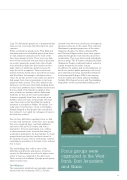
Capturing Palestinian perspectives on human security
Focus groups were organised in the West Bank, East Jerusalem and Gaza.