


Page 14 - TORCH Magazine #30 - Spring 2026
P. 14
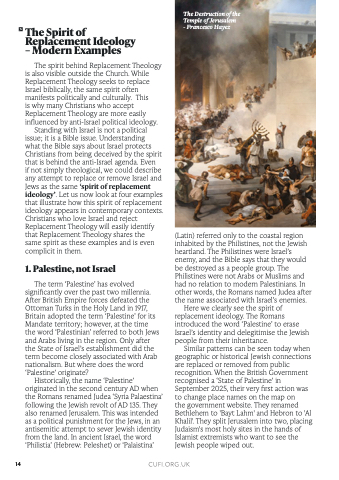
The Destruction of the
Temple of Jerusalem
The Spirit of Replacement Ideology – Modern Examples
- Francesco Hayez
The spirit behind Replacement Theology
is also visible outside the Church. While
Replacement Theology seeks to replace
Israel biblically, the same spirit often
manifests politically and culturally. This
is why many Christians who accept
Replacement Theology are more easily
influenced by anti-Israel political ideology.
Standing with Israel is not a political
issue; it is a Bible issue. Understanding
what the Bible says about Israel protects
Christians from being deceived by the spirit
that is behind the anti-Israel agenda. Even
if not simply theological, we could describe
any attempt to replace or remove Israel and
Jews as the same ‘spirit of replacement
ideology’. Let us now look at four examples
that illustrate how this spirit of replacement
ideology appears in contemporary contexts.
Christians who love Israel and reject
Replacement Theology will easily identify
that Replacement Theology shares the
same spirit as these examples and is even
complicit in them.
1. Palestine, not Israel
The term ‘Palestine’ has evolved
significantly over the past two millennia.
After British Empire forces defeated the
Ottoman Turks in the Holy Land in 1917,
Britain adopted the term ‘Palestine’ for its
Mandate territory; however, at the time
the word ‘Palestinian’ referred to both Jews
and Arabs living in the region. Only after
the State of Israel’s establishment did the
term become closely associated with Arab
nationalism. But where does the word
‘Palestine’ originate?
Historically, the name ‘Palestine’
originated in the second century AD when
the Romans renamed Judea ‘Syria Palaestina’
following the Jewish revolt of AD 135. They
also renamed Jerusalem. This was intended
as a political punishment for the Jews, in an
antisemitic attempt to sever Jewish identity
from the land. In ancient Israel, the word
‘Philistia’ (Hebrew: Peleshet) or ‘Palaistina’
14 CUFI.ORG.UK
(Latin) referred only to the coastal region
inhabited by the Philistines, not the Jewish
heartland. The Philistines were Israel’s
enemy, and the Bible says that they would
be destroyed as a people group. The
Philistines were not Arabs or Muslims and
had no relation to modern Palestinians. In
other words, the Romans named Judea after
the name associated with Israel’s enemies.
Here we clearly see the spirit of
replacement ideology. The Romans
introduced the word ‘Palestine’ to erase
Israel’s identity and delegitimise the Jewish
people from their inheritance.
Similar patterns can be seen today when
geographic or historical Jewish connections
are replaced or removed from public
recognition. When the British Government
recognised a ‘State of Palestine’ in
September 2025, their very first action was
to change place names on the map on
the government website. They renamed
Bethlehem to 'Bayt Lahm' and Hebron to 'Al
Khalil'. They split Jerusalem into two, placing
Judaism's most holy sites in the hands of
Islamist extremists who want to see the
Jewish people wiped out.


