


Page 24 - TORCH Magazine #30 - Spring 2026
P. 24
future in music. They could see that I had
music in my soul. They really wanted me
to be something in life. And music was it.
Appreciating my every effort.”
Louis didn’t spend all his childhood with
the Karnofsky’s; he dropped out of school
at age 11 and shortly after he was arrested
for firing his stepfather’s pistol into the air
in celebration on New Year’s Eve. He was
sent to the ‘Colored Waif’s Home for Boys’.
It was here that he received his first formal
training in music.
When he was released, he went back
to the streets. He had a tough early life.
His mother was a prostitute, and sadly the
men in her life were often abusive to Louis.
Growing up in that world, he decided at the
age of 15 he would become a pimp, but after
getting stabbed by the only woman working
for him, he realised this wasn't the life he
wanted. He worked for the Karnofsky’s
again until he was 17 and then had the
opportunity to join a band on a river boat.
The makeshift stage wasn’t glamourous, but
it was there that he learned to read sheet
music and hone his skills through nonstop
playing and improvisation as he adapted to
whatever the crowd or the occasions that
were happening on the steamboat, which he
later described as “my university.”
It was music, and the nurturing of that
talent, that gave him a lifeline out of the
world of crime and poverty. He later moved
to Chicago to perform in jazz clubs across
the city, and then on to the Big Apple
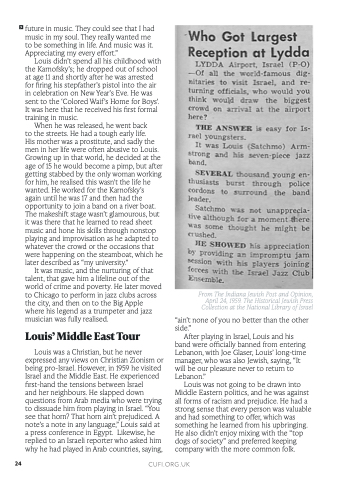
From The Indiana Jewish Post and Opinion, April 24, 1959. The Historical Jewish Press Collection at the National Library of Israel
where his legend as a trumpeter and jazz
musician was fully realised.
“ain’t none of you no better than the other
side.”
Louis’ Middle East Tour
After playing in Israel, Louis and his
band were officially banned from entering
Louis was a Christian, but he never
expressed any views on Christian Zionism or
being pro-Israel. However, in 1959 he visited
Israel and the Middle East. He experienced
first-hand the tensions between Israel
and her neighbours. He slapped down
questions from Arab media who were trying
to dissuade him from playing in Israel. “You
see that horn? That horn ain’t prejudiced. A
note’s a note in any language,” Louis said at
a press conference in Egypt. Likewise, he
replied to an Israeli reporter who asked him
why he had played in Arab countries, saying,
Lebanon, with Joe Glaser, Louis’ long-time
manager, who was also Jewish, saying, “It
will be our pleasure never to return to
Lebanon.”
Louis was not going to be drawn into
Middle Eastern politics, and he was against
all forms of racism and prejudice. He had a
strong sense that every person was valuable
and had something to offer, which was
something he learned from his upbringing.
He also didn’t enjoy mixing with the “top
dogs of society” and preferred keeping
company with the more common folk.
24 CUFI.ORG.UK


