Page 19 - 2019 December E-issue
P. 19
Reimagining Additive Manufacturing of
Carbon Composite Lattice Structures
by Pritam Poddar
Additive Manufacturing (AM) is gradually being adopted be at least 5X faster as it eliminates non-value adding
as the manufacturing technology of the future. One of movement like printing support material. ALE also
the biggest benefits of this technology is that it allows us allows preferential fiber alignment, which is impossible
to create geometry which is impossible with traditional to achieve with 2D layer based extrusion, as seen in
manufacturing technology. For example, AM can be Figure 2.
used for making lattice structures, a geometry inspired
by nature. These geometries have a high strength-
to-weight ratio and thus composite lattice structures
are used in aerospace, architecture and automotive
applications. Manufacturing these lattice structures
is challenging, because they are made of periodic
cellular cells which need to be fabricated separately,
assembled and joined. In this work, we describe how
AM was reimagined to combine the separate fabrication,
assembly and joining of carbon composite lattice
structures into one single process.
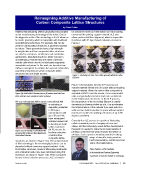
Figure 3 - Fabricating an Octet Truss Lattice geometry with Axial Lattice
Extrusion
Figure 3 demonstrates how the ALE process can
extrude material directly into 3D space without requiring
support material. When the carbon fiber composite is
Figure 1(a) Axial Lattice Extrusion process (b) various sized octet truss extruded at 240˚C from the nozzle, it is in a semi-solid
lattice structure made using Axial Lattice Extrusion state and gradually transforms back into a solid state
as the temperature decreases. In the ALE process,
We say reimagining AM because conventional AM the temperature of the hot exiting filament is rapidly
is extruding or decreased by blowing chilled air at it. This accelerates
depositing materials the transformation of the material from semi-solid to a
in 2D layers solid and can hold its position in space without support
repeatedly to build material. It enables the printing of features of up to 90
up a 3D part. We degrees overhang.
have reimagined
extrusion-based AM Currently the ALE process is capable of fabricating
to develop an Axial cellular sandwich panels of varying cell size and
Lattice Extrusion shape, and the technology needs further development.
Figure 2 (a) 2D layering in conventional AM (ALE) process for Research is needed to make the process capable of
processes (b) Continuous fiber alignment in freeform extrusion printing a solid skin that would enclose the lattice on
Axial Lattice Extrusion of carbon fiber all sides. Such a process would be useful for making
composite lattice wings of aircrafts, body panels in
structures, as shown in Figure 1 (a). The unique feature land transportation, architectural and
of this technology is that overhanging features can be many other applications.
deposited without using any support material. Octet
truss lattice structures, made of alternating tetrahedral Pritam Poddar is a PhD Candidate
and octahedral cells, have been fabricated using this in the Industrial and Systems Engineering
technique, as shown in Figure 1 (b). When compared Department at Rochester Institute of Technology.
to layer-based extrusion processes, ALE is found to
cover article feature article DECEMBER 2019 The ROCHESTER ENGINEER | 19