


Page 65 - 2007 DT 12 Issues
P. 65
In This Issue !


                                                                                     Featured Article

                                                                                      SOS—The Early Days....................1

                                                                                     Departments
                                                                                      News & Notes.................................2
                                                                                      Programs & Hikes...........................4
                                       September  2007                                Desk Schedule...............................6
                                                                                      Bulletin Board................................8


        SOS—THE EARLY DAYS                   on December 12, 1901, a message  proved its worth.
        OF WIRELESS AT  SEA                  was sent transatlantic. It was just a   Although there had  been  some
                                             simple  “S”  in  Morse  code—three  earlier uses of wireless in rescue at
                                             dots—but it brought in the miracle of  sea, nothing loomed as large as the
        by Louis C. Kleber
                                             wireless communication.              January 1909 collision off Nantucket
                                                 By 1904, many ships in the Atlantic  in a dense fog of the White Star’s Re-
               he  year  was  1854,  and  the
               steamer City of Glasgow disap-  trade were equipped with wireless sets.  public and the Italian ship, Florida.
        Tpeared into the North Atlantic      Both on land and sea, “CQ” was used  Over 1,500 passengers and crew were
                                             as a “seeking all stations” call. If the  on board the two ships. Fortunately,
        with  nearly  500  people  on  board.   message was for urgent help, “D” was  the Republic was equipped with wire-
        Whatever the drama and terror of her   added to signal distress. Thus “CQD”  less. Her Marconi operator (as they
        final moments, one of the worst must
        have been the inability to call for help.   was born, and                                   were then called),
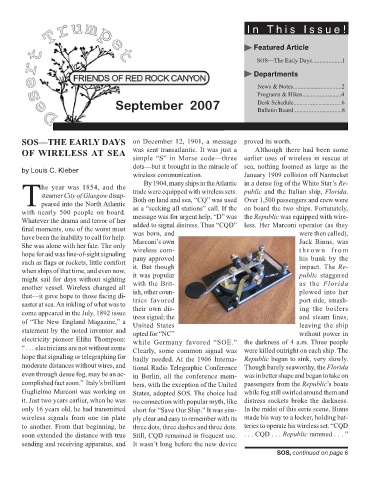
        She was alone with her fate. The only   Marconi’s own                                       Jack  Binns,  was
                                                                                                    t h r o w n   f r o m
                                             wireless com-
        hope for aid was line-of-sight signaling   pany approved                                    his  bunk  by  the
        such as flags or rockets, little comfort   it. But though                                   impact. The  Re-
        when ships of that time, and even now,
        might sail for days without sighting   it was popular                                       public staggered
        another vessel. Wireless changed all   with  the  Brit-                                     as  the  Florida
                                             ish, other coun-
                                                                                                    plowed  into  her
        that—it gave hope to those facing di-  tries  favored                                       port side, smash-
        saster at sea. An inkling of what was to   their own dis-                                   ing  the  boilers
        come appeared in the July, 1892 issue   tress signal; the                                   and steam lines,
        of “The New England Magazine,” a     United  States                                         leaving  the  ship
        statement by the noted inventor and   opted for “NC”                                        without power in
        electricity pioneer Elihu Thompson:     while  Germany  favored  “SOE.”  the darkness of 4 a.m. Three people

        “ . . . electricians are not without some   Clearly,  some  common  signal  was  were killed outright on each ship. The
        hope that signaling or telegraphing for   badly needed. At the 1906 Interna-  Republic began to sink, very slowly.
        moderate distances without wires, and   tional Radio Telegraphic Conference  Though barely seaworthy, the Florida
        even through dense fog, may be an ac-  in Berlin, all the conference mem-  was in better shape and began to take on
        complished fact soon.”  Italy’s brilliant   bers, with the exception of the United  passengers from the Republic’s boats
        Guglielmo Marconi was working on     States, adopted SOS. The choice had  while fog still swirled around them and
        it. Just two years earlier, when he was   no connection with popular myth, like  distress rockets broke the darkness.
        only 16 years old, he had transmitted  short for “Save Our Ship.” It was sim-  In the midst of this eerie scene, Binns
        wireless signals from one tin plate  ply clear and easy to remember with its   made his way to a locker, holding bat-
        to another. From that beginning, he  three dots, three dashes and three dots.   teries to operate his wireless set. “CQD
        soon extended the distance with true  Still, CQD remained in frequent use.   . . . CQD . . . Republic rammed . . . ”
        sending and receiving apparatus, and  It wasn’t long before the new device
                                                                                             SOS, continued on page 6

