


Page 10 - 2006 DT 12 Issues
P. 10
Beating the Odds                     larity to  ancient progenitors. They  survived so long.
                                             display many features that are clearly    Ecologist Steven Austad of the
                orseshoe  crabs  are  among  primitive.  No one can say how ani-  University of Idaho says, “Sheer luck
                earth’s oldest creatures. Not  mals functioned millions of years ago,  is a major consideration” in determin-
        Hreally crabs at all, they are  however, these “fossils” are definitely dif-  ing survival. It might be no more than

        closely related to scorpions, ticks and  ferent from other species of their kind.   accidentally dodging a lethal “bullet”
        land spiders. For at least 300 million    Living fossils are usually found  that hits a non-vital spot on one’s DNA;
        years,  these  slow-moving  aquatic  at the end of very long branches in the  having no significant predators; or not
        animals have gone about their busi-  tree of life. “What is significant is that  being in the wrong place at the wrong
        ness virtually unchanged. Their fossils  the lineage to which they belong is  time, avoiding extinction.
        have been found in 360 million-year-  isolated phylogenetically,” says evo-    Luck aside, many animals and
        old sediments looking much the same  lutionary biologist David Wake of the  organisms exhibit defensive strategies
        as they do today. Considered “living  University of California at Berkeley.  that have stood the test of time. Mil-
        fossils,” they are close relatives of  “This means they have no close or very  lipedes have many forms of defense.
        the now extinct primitive arthropods  close relatives.”                   One species with an exoskeleton coils
        known as trilobites, and evolved                                          up its segmented body to repel attacks.
        in the same warm shallow seas                                             An ancient species, possibly the oldest,
        of the Paleozoic Era. Why have                                            uses barbed grappling hooks to fend
        they survived so long?                                                    off hungry ants.
             Scientists generally agree                                                Some animals use chemicals or
        that 99.9 percent of all species                                          noxious, irritating fluids for defense.
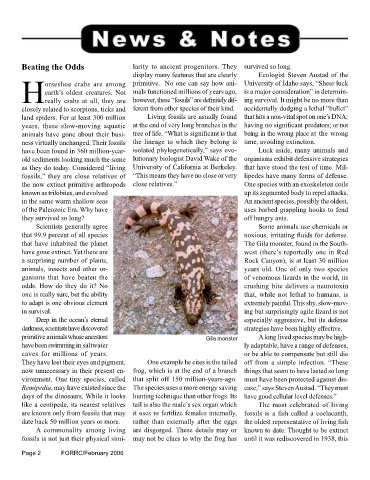
        that have inhabited the planet                                            The Gila monster, found in the South-
        have gone extinct. Yet there are                                          west (there’s reportedly one in Red
        a surprising number of plants,                                            Rock Canyon), is at least 30 million
        animals, insects and other or-                                            years old. One of only two species
        ganisms that have beaten the                                              of venomous lizards in the world, its
        odds. How do they do it? No                                               crushing bite delivers a neurotoxin
        one is really sure, but the ability                                       that, while not lethal to humans, is
        to adapt is one obvious element                                           extremely painful. This shy, slow-mov-
        in survival.                                                              ing but surprisingly agile lizard is not
             Deep in the ocean’s eternal                                          especially aggressive, but its defense
        darkness, scientists have discovered                                      strategies have been highly effective.
        primitive animals whose ancestors                            Gila monster      A long lived species may be high-
        have been swimming in saltwater                                           ly adaptable, have a range of defenses,
        caves  for  millions  of  years.                                          or be able to compensate but still die
        They have lost their eyes and pigment,    One example he cites is the tailed  off from a simple infection. “These
        now unnecessary in their present en-  frog, which is at the end of a branch  things that seem to have lasted so long
        vironment. One tiny species, called  that split off 150 million-years-ago.  must have been protected against dis-
        Remipedia, may have existed since the  The species uses a more energy saving  ease,” says Steven Austad. “They must
        days of the dinosaurs. While it looks  hunting technique than other frogs. Its  have good cellular level defenses.”
        like a centipede, its nearest relatives  tail is also the male’s sex organ which   The most celebrated of living
        are known only from fossils that may  it uses to fertilize females internally,  fossils is a fish called a coelacanth,
        date back 50 million years or more.  rather than externally after the eggs  the oldest representative of living fish
             A  commonality  among  living  are disgorged. These details may or  known to date. Thought to be extinct
        fossils is not just their physical simi-  may not be clues to why the frog has  until it was rediscovered in 1938, this

        Page 2           FORRC/February 2006

