


Page 19 - Macroeconomics. book docx_Neat
P. 19
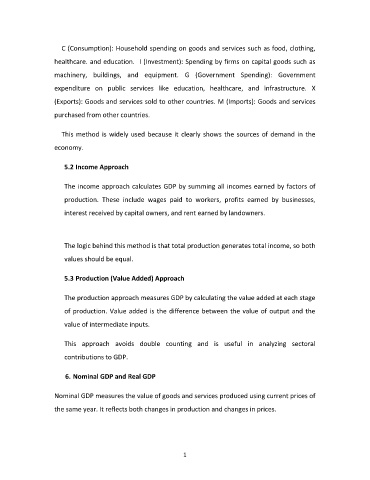
C (Consumption): Household spending on goods and services such as food, clothing,

                   healthcare. and education.  I (Investment): Spending by firms on capital goods such as

                   machinery,  buildings,  and  equipment.  G  (Government  Spending):  Government

                   expenditure  on  public  services  like  education,  healthcare,  and  infrastructure.  X
                   (Exports): Goods and services sold to other countries. M (Imports): Goods and services

                   purchased from other countries.


                     This method is widely used because it clearly shows the sources of demand in the

                   economy.


                      5.2 Income Approach


                      The income approach calculates GDP by summing all incomes earned by factors of
                      production.  These  include  wages  paid  to  workers,  profits  earned  by  businesses,

                      interest received by capital owners, and rent earned by landowners.


                      The logic behind this method is that total production generates total income, so both

                      values should be equal.


                      5.3 Production (Value Added) Approach


                      The production approach measures GDP by calculating the value added at each stage

                      of production. Value added is the difference between the value of output and the
                      value of intermediate inputs.


                      This  approach  avoids  double  counting  and  is  useful  in  analyzing  sectoral

                      contributions to GDP.


                       6. Nominal GDP and Real GDP


                   Nominal GDP measures the value of goods and services produced using current prices of

                   the same year. It reflects both changes in production and changes in prices.


                                                              19

